
ATV Accessories That Improve Dealer Margins: A Sourcing Guide
How to improve your ATV accessories dealer margins: high-margin categories, wholesale sourcing options, bundling strategies, and seasonal demand patterns.
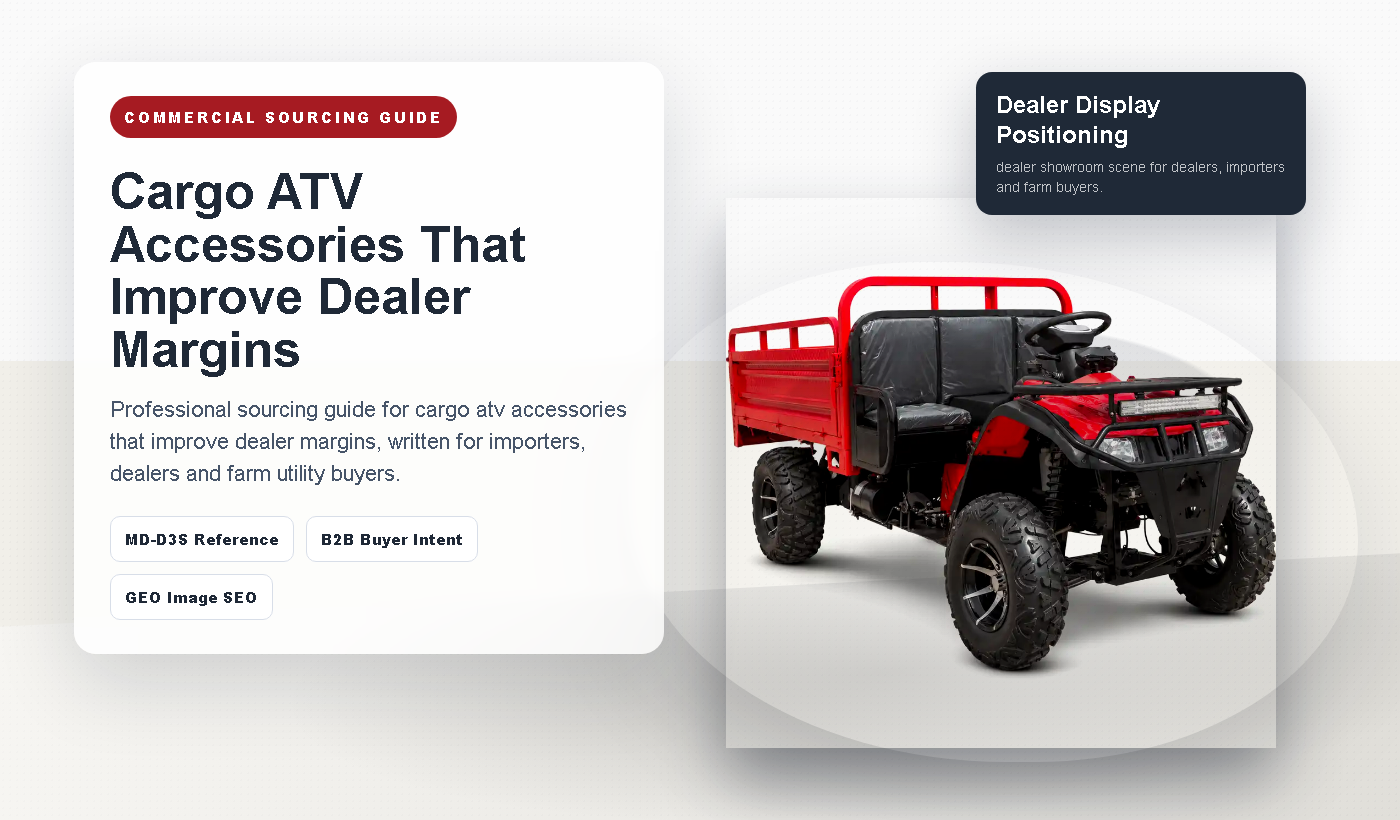
ATV Accessories That Improve Dealer Margins: A Sourcing Guide
The profit in an ATV sale rarely lives in the machine itself. Once you account for freight, floor-plan interest, and the price comparison your customer already ran on their phone, the unit margin on a single quad often shrinks to a thin sliver. The money is made after the sale — in winches, windshields, cargo racks, lighting, and the service parts that keep every machine running season after season. This guide is written for importers, dealers, and OEM sourcing teams who want to improve ATV accessories dealer margins without adding showroom space or headcount. It covers the categories that actually move, their typical margin profiles, how demand shifts through the year, and the sourcing options that separate a profitable accessory program from slow-moving shelf clutter.
Why Accessories Are the Margin Engine of an ATV Dealership
Machines are transparent; accessories are not. A customer can price a quad across three dealers in five minutes, but the same customer rarely compares the price of a plow mount or a mirror kit with the same rigor. That pricing asymmetry is exactly why accessories deserve a structured program rather than a few impulse items near the register.
Look at the economics. A new ATV carries a large ticket price, heavy freight, and financing costs, and it typically sits on your floor plan for weeks before it moves. Accessories, by contrast, are small, light, and fast-moving. Dealers who track category-level profit consistently find that accessories deliver a gross-profit contribution out of proportion to the floor space and working capital they consume. Most dealerships with an organized accessory program report attachment rates of one to three accessory purchases per machine sold, with accessory margins sitting comfortably above vehicle margins in almost every month of the year.
There is also a service angle. Every accessory that bolts onto a machine — a winch, a lift kit, a tire upgrade — creates installation work, and every installed accessory creates future demand for service parts and consumables. A customer who buys a winch today is a customer who needs synthetic rope, remote kits, and fairleads next season. That repeat revenue is what turns a one-time unit sale into a multi-year relationship, and it is why accessory programs are the first thing well-run dealerships build once their machine inventory is under control.
Margin Profiles: Which ATV Accessories Pay for the Shelf Space
Not every accessory deserves the same shelf position or the same buying commitment. The table below summarizes the typical margin and demand characteristics of the main accessory categories as sourcing teams and dealers generally assess them. Use it as a starting point for category planning, then refine the assumptions with your own sales history.
| Accessory Category | Typical Margin Profile | Demand Drivers | Inventory Risk |
|---|---|---|---|
| Winches & recovery gear | High | Hunting, farming, recovery, winter plowing | Low |
| Cargo racks & storage boxes | High | Utility users, ranchers, hunters | Low to medium |
| Windshields | Medium to high | Cold-weather riding, commuting, plowing | Medium — fitment variance |
| Mirrors & lighting | High | Road-legal conversion, night riding, safety | Low |
| Tire & wheel upgrades | Medium | Mud season, sport riders, terrain changes | Medium — bulky, model-specific |
| Service parts & consumables | Medium but recurring | Every machine, every season | Low if you track usage |
Two patterns stand out. First, the highest-margin items tend to be small, bolt-on, and tied to a specific use case — a winch for a farmer, a light bar for a night rider. Second, the most predictable margin comes from consumables, because they sell to every machine owner regardless of how the vehicle is used. The most profitable ATV parts for your market are the ones that turn fast and solve a visible problem. A balanced program mixes both: high-margin project items that drive attachment rates, and consumable lines that drive repeat visits and service revenue.
The High-Margin ATV Accessory Categories Worth Stocking
Winches and Recovery Gear
The winch is the most common first accessory dealers sell, and for good reason. It solves a real problem — getting stuck — and it is nearly impossible for the customer to compare across brands without help, which gives the dealer genuine pricing power. Winch kits, mounting plates, synthetic rope, remote controls, and snatch blocks all carry strong margins, and the install is a natural service upsell. Stock a small range that covers the most common machine weights in your market, and keep the accessory line stocked even when machine inventory is low.
Cargo Racks and Storage Boxes
Utility riders, ranchers, and hunters buy cargo capacity almost as soon as they buy the machine. Front and rear racks, aluminum storage boxes, and saddlebags attach to the vehicle, so the customer is buying a solution rather than a commodity. These products are bulky, which means freight and packaging matter: work with suppliers who offer consolidated shipping and packaging that survives handling. The margin per unit is strong, and attachment rates for this category are consistently high among utility-machine owners.
Windshields
Windshields are a category with medium-to-high margins and a genuine seasonal story — demand climbs sharply when temperatures drop and riders start commuting or plowing. The main complication is fitment. A returned windshield is an expensive problem, so deal with suppliers that publish clear fitment charts and model coverage lists, and train staff to confirm machine model and year before an order is placed. Polycarbonate shields are lighter and more shatter-resistant than glass, which also reduces freight damage and return rates.
Mirrors and Lighting
Mirror kits, LED light bars, headlight upgrades, tail lights, and turn-signal kits are small, cheap to ship, and easy to install — a combination that produces excellent margins and very low inventory risk. Lighting in particular has become a year-round category as more riders use machines after dark and municipalities push road-legal conversions. These are also the products customers buy on impulse while already in the showroom, so display them where waiting customers can touch them.
Tire and Wheel Upgrades
Tires carry medium margins because they are bulky and model-specific, but they are also one of the few accessories every machine needs eventually. Mud-season demand spikes are predictable in most regions, and a customer who upgrades tires today often upgrades wheels, lifts, and fender flares next season. The winning approach is to stock only the fastest-moving sizes in your market and to pre-order before the seasonal peak rather than chasing it with expensive expedited freight.
Service Parts and Consumables
Filters, belts, chains, spark plugs, brake pads, oils, and lubes are the quiet margin engine of the dealership. Individually unglamorous, collectively they generate steady, repeatable gross profit with almost no sales effort — the customer needs them, and the only question is whether they buy from you or from an online retailer. Stocking fast-moving service parts turns every service visit into an additional sale, and it is the category most likely to keep a customer coming back even when they bought the machine elsewhere.
How to Improve ATV Accessories Dealer Margins Through Smart Sourcing
Where you buy determines your margin more than almost any other decision. Dealers typically choose between several sourcing routes, and most successful operations mix at least two of them:
- Domestic distributors: fast restock, low minimums, and easy returns — the right choice for fitment-sensitive and bulky items such as windshields and tires. You trade some margin for speed and flexibility.
- Direct factory import: the lowest unit cost and the best margin potential, but it requires volume, container planning, and patience. Typical export lead times from major manufacturing regions run from several weeks to a couple of months, so direct import works best for high-turnover SKUs with stable fitment.
- Group buying or pooled orders: several dealers or a buying group combine orders to reach factory minimum order quantities without each member committing to full-container volume. This is a practical middle path for medium-sized dealers.
- Cross-border wholesale platforms and trade shows: useful for discovering new lines, comparing unit prices, and building supplier relationships before committing to a full container. Always order samples first.
Whichever route you choose, treat accessory sourcing as a skill rather than a one-time event. Unit prices, freight rates, and exchange rates move constantly, so the dealers who win are the ones who re-quote their key lines on a fixed schedule and renegotiate as volumes grow.
Demand Patterns: When Dealers Should Stock Up
Accessory demand is more seasonal than many dealers expect, and the pattern repeats every year. In spring, mud season drives tire, lift kit, and winch sales as riders prepare for wet trails. In late summer and fall, hunters and ranchers buy cargo racks, storage boxes, and lighting. Winter brings windshields, plow kits, heaters, and cold-weather gear for commuters and property owners. Service parts and consumables, by contrast, sell steadily all year and spike around machine service intervals.
The practical implication is that you should be buying for next season while this season's demand is still peaking. If you order winter windshields in November, you are already late. The dealers with the best margins order against the season calendar, consolidate seasonal orders to control freight, and carry the fast movers year-round so they never lose a sale to an online competitor with a warehouse two days away.
Bundling Strategies That Raise Average Order Value
Bundling is the cheapest growth lever in the accessory business because it requires no new inventory — it only changes how you present what you already stock. Done well, it turns the classic dealer upsell into a service the customer appreciates rather than resists. The most effective patterns dealers use include:
- Unit-sale packages: pair every new machine with a trail-ready or utility package at a small discount versus buying separately. Even a modest package discount can lift attachment rates dramatically, because the customer perceives the bundle as a single decision.
- Seasonal packages: a plow package in late autumn, a mud-season tire package in early spring, a lighting package before hunting season. Timing the bundle to the season converts browsing into purchase.
- Service-linked offers: include a filter-and-fluid service kit with the first service, or discount accessories when booked with installation. This protects both service revenue and parts margin.
- Trade-up incentives: credit part of the accessory purchase toward a future machine upgrade. It costs little today and builds the loyalty that produces the next unit sale.
Track attachment rate — accessories sold per machine sold — as your headline metric. Most dealers find that a structured bundling program moves this number more than any pricing change, because it removes the need for the customer to initiate the upsell.
What to Look For in an ATV Accessory Supplier
Reliable sourcing beats the lowest quoted price almost every time. When you evaluate a potential supplier — whether a domestic distributor or a factory overseas — check these points before committing volume:
- Fitment documentation: do they publish model coverage lists and fitment charts? Ask for them before ordering, not after a return arrives.
- Consistent quality: order samples and inspect them personally. Check welds, plastics, hardware, and packaging. Quality problems destroy margin through returns and warranty claims faster than any price advantage can recover.
- Packaging and freight: bulky items like racks and windshields live or die by packaging. Ask how the supplier packs for export and whether they offer consolidated shipping for mixed accessory orders.
- Lead times and communication: typical export lead times are the baseline; what matters is whether the supplier actually meets them. Ask for a written schedule and confirm how delays are handled.
- Payment terms: understand the payment structure before you commit. Terms that tie up your cash for months can quietly erase a margin advantage.
- After-sales support: who answers fitment questions, and how are missing or damaged parts handled? A supplier that replaces damaged parts without friction is worth more than one that saves a few percent per unit.
Managing Accessory Inventory Without Tying Up Cash
The margin numbers in this guide are only realized if inventory actually turns. Slow-moving accessories are worse than no accessories — they consume floor space, absorb working capital, and eventually get discounted, which poisons your margin story. Practical habits that keep accessory inventory healthy:
- Rank by turn, not just by margin: a consumable that turns twelve times a year at a moderate margin generates more profit per dollar invested than a windshield that turns twice at a higher margin. Manage the mix, not only the percentages.
- Set reorder points: know the minimum stock level for each fast mover and reorder before you hit it. A stockout during peak season is a lost sale plus a customer who learns to buy elsewhere.
- Review dead stock quarterly: anything that has not moved in a season should be discounted, bundled, or returned if the supplier allows it. Clear it before it becomes a permanent fixture.
- Use supplier stock as your warehouse: for bulky or fitment-sensitive items, prefer distributors that can restock quickly, so your cash stays in fast-moving lines.
Frequently Asked Questions
What are the most profitable ATV accessories for dealers?
Winches, cargo racks, storage boxes, mirrors, and lighting kits generally carry the strongest margins because they are bolt-on, use-case-driven, and hard for customers to price-compare. Service parts and consumables offer slightly lower per-unit margins but far higher turnover, which makes them extremely profitable per dollar invested. The best accessory programs combine both.
Where can dealers buy ATV accessories wholesale?
Dealers typically source through domestic distributors for fast restock and easy returns, direct factory imports for the lowest unit cost on high-volume lines, group-buying arrangements to reach factory minimums, and cross-border wholesale platforms or trade shows for discovery and comparison. Most successful dealers run a mix of two or more of these routes and re-quote their key lines regularly.
How much margin can dealers expect on ATV accessories?
Expectations vary by category, market, and sourcing route, but dealers generally view accessory margins as significantly stronger than machine margins. Winches, racks, mirrors, and lighting tend to sit at the higher end of the range, while tires and bulky items run lower due to freight and fitment risk. The exact figures depend on your cost of goods, freight, and how disciplined you are about discounting.
What is a typical lead time for importing ATV accessories?
Typical export lead times from major manufacturing regions range from several weeks to a couple of months, depending on the product, the supplier's production schedule, and the shipping route you choose. Dealers who import plan seasonal buys months ahead and consolidate orders to control freight cost. If you need stock faster, domestic distribution is the usual alternative, at a lower margin.
How should dealers price accessories relative to the ATV?
Price accessories on their own value, not as a percentage of the machine price. A customer who just spent thousands on a quad does not flinch at a winch kit priced with a healthy margin — but they will notice if the same kit is cheaper online. Set prices that reflect the convenience, fitment guarantee, and installation service you provide, and use package pricing at the unit sale to encourage attachment.
Do ATV accessories require certifications?
Certification requirements depend on your market and the product. Lighting and electrical items may be subject to local standards, and road-legal conversion kits typically must meet regional vehicle regulations. Ask your supplier for documentation up front, verify it against your market's rules, and keep records for every SKU. A certification gap discovered after a container arrives is an expensive problem.
The bottom line: ATV accessories are not a side business — they are the part of the dealership that compounds. Machines bring customers in; accessories, service parts, and the relationships they build keep them coming back. Build the category with the same discipline you apply to machine inventory, source for margin rather than for the lowest invoice, bundle with intent, and the accessory program will quietly become the most reliable profit center you run.