ATV Cargo Racks vs Rear Beds vs Trailers: Use Case Comparison
ATV cargo rack vs trailer: compare racks, rear beds, and utility trailers for farm and ranch hauling. Capacity, stability, cost, and use cases compared.
ATV Cargo Racks vs Rear Beds vs Trailers: Use Case Comparison
Every utility ATV purchase eventually comes down to one practical question: how will the machine carry the load? For importers, dealers, and OEM sourcing teams, the decision between an ATV cargo rack vs trailer shapes the entire specification, from the machine you order to the accessories you stock beside it. Three solution families dominate the market: front and rear cargo racks, rear-mounted cargo beds, and purpose-built ATV trailers. Each moves different payloads, changes how the machine handles, and earns its keep in different farm, ranch, and utility tasks. This guide compares them on capacity, stability, cost, ease of use, and the daily realities of working a property, so you can match the configuration to the application instead of defaulting to the cheapest option.
The Three Load-Carrying Solutions Explained
Front and Rear Cargo Racks
Most utility ATVs ship with at least a rear rack, and many carry a front rack as well. A rack is a flat platform bolted to the machine's frame, typically built from powder-coated steel, aluminum, or polymer-reinforced composite. The rear rack sits behind the rider and is the workhorse position for everyday loads; the front rack rides over the fenders and suits lighter items you want to keep in sight. Because racks ride on the machine itself, they add almost no length to the vehicle and do not change its turning radius. Loads are secured with ratchet straps, cargo nets, or bungee cords against factory tie-down points. The trade-off is capacity: racks carry far less than a bed or trailer, and every kilogram you add sits directly on the ATV's suspension, steering, and brakes. An ATV cargo rack is the right answer when the load is small, frequent, and close to the work site.
Rear Cargo Beds
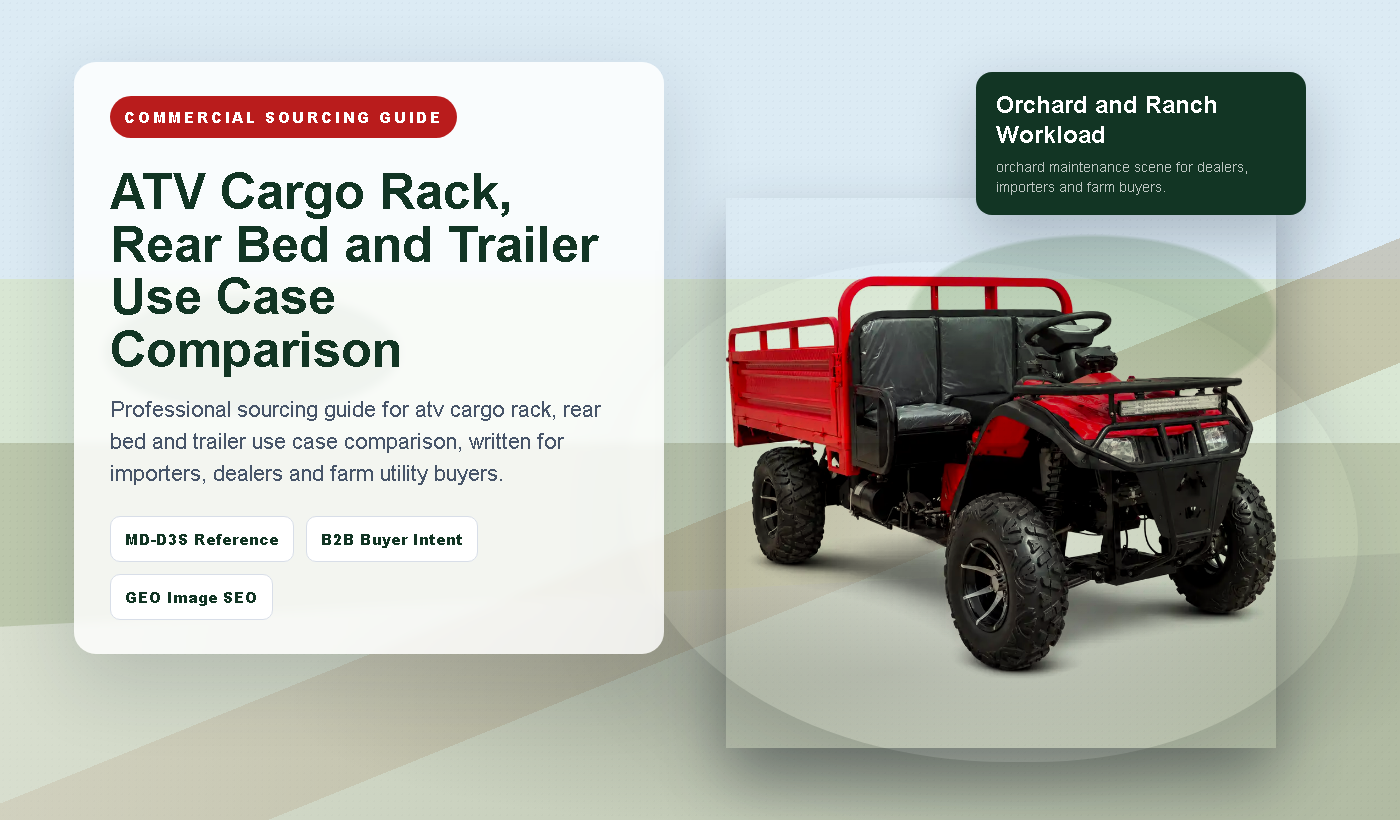
A rear bed is a box-shaped platform mounted behind the rider, usually over the rear wheels, with fixed side rails and a tailgate. Many beds tip to dump, which is a major advantage when unloading gravel, seed, or manure. Beds carry more than racks because they spread the load over a larger footprint and sit lower, closer to the rear axle, where the machine can support it. Typical capacity on current utility models lands in the 180 to 270 kg (400 to 600 lb) range. Beds are permanent fixtures: you cannot remove one quickly when the machine needs to carry a passenger or fit into a tight shed. For B2B buyers, an ATV rear bed is usually a factory option or dealer-installed accessory, so chassis compatibility, suspension tuning, and fender geometry must be confirmed at the point of specification, not after delivery.
ATV Trailers
A utility trailer is a separate axle-and-wheel unit hitched to the machine through a tow ball or receiver mount. An ATV trailer ranges from compact 1.2 m (4 ft) bed units for feed and fencing to larger 1.8 m and 2.4 m (6 ft and 8 ft) models for timber, water tanks, and bulk material. Because the trailer carries its own load on its own axle, the ATV's suspension is not asked to absorb the full payload. Towing capacity on utility ATVs typically runs from 400 kg to 900 kg (900 to 2,000 lb), with heavier machines and geared-down drivetrains at the top of that band. The costs are maneuverability and skill: a loaded trailer extends stopping distance, changes turn behavior, and must be backed carefully. Trailers also need secure parking, and the hitch must be inspected and maintained.
ATV Cargo Rack vs Trailer: Capacity and Payload Compared
The single most important specification in any load-carrying decision is payload. The table below summarizes typical planning figures for current utility ATVs and standard accessories. Treat the numbers as ranges, not guarantees: actual capacity depends on the specific machine, terrain, tire type, and how the load is distributed.
| Solution | Typical Payload | Load Placement | Best Work Pattern | Typical Cost Tier |
|---|---|---|---|---|
| Front rack | 45-90 kg (100-200 lb) | Over the front wheels | Light tools, small bags, items needing visibility | Low |
| Rear rack | 90-135 kg (200-300 lb) | Behind the rider | Daily carry: fuel, chain saw, fencing gear | Low |
| Rear cargo bed | 180-270 kg (400-600 lb) | Over the rear axle | Bulk but bounded: feed, seed, gravel bags, manure | Medium |
| Utility trailer | 350-700 kg (770-1,540 lb) towed | On its own axle, behind the machine | Heavy or bulky: timber, water, equipment, long hauls | Medium to high |
Reading the table, a clear pattern emerges: the more weight you move, the more hardware you need. A rack suits loads under about 135 kg. A bed roughly doubles the practical ceiling while keeping the load on the machine. An ATV trailer roughly doubles it again, but moves the weight off the ATV entirely and onto its own wheels.
Payload is never a fixed number. Every capacity figure in this comparison assumes level ground and moderate speed. On slopes, soft ground, or rutted pasture, effective capacity drops, sometimes by 30 percent or more, because the drivetrain, brakes, and tires must work harder. Trailers compound the effect: towing ratings assume smooth, level surfaces, and most manufacturers expect owners to derate for hills and rough terrain. A trailer that carries 500 kg on a gravel road will struggle with the same load up a steep pasture incline.
Stability, Ride Dynamics, and Safety
Where you place a load changes how the ATV behaves. Front racks push weight onto the steering axle, which can improve traction but dulls steering and makes the front end feel heavy in turns and descents. Rear racks raise the load high behind the rider, so steep climbs can lighten the front wheels; overloading a rear rack is a common cause of wheelies on slopes. Beds sit lower and closer to the rear axle, which is the best mass position on the machine itself: the weight acts through the rear wheels instead of behind them. That is why a loaded bed feels more planted than a loaded rack at comparable weights.
Trailers change the physics entirely. A properly loaded trailer carries roughly 10 to 15 percent of its gross weight as tongue weight on the hitch, which presses down on the rear of the ATV and improves rear traction. Too little tongue weight invites sway at speed; too much can overwhelm the rear suspension. A loaded trailer also lengthens braking distance significantly, and an ATV without trailer brakes relies entirely on the machine's own brakes for both vehicle and load. On steep descents, most experienced operators recommend trailer brakes for gross loads above about 500 kg (1,100 lb), even where regulations do not require them.
Safety rules for end customers: never exceed the combined rating of machine and accessory, keep heavy items low and centered, distribute loads evenly side to side, and reduce speed whenever the load exceeds half the rated capacity.
Cost Analysis for B2B Buyers
For importers and dealers, cost means far more than the wholesale price of the accessory. Racks are the cheapest solution at both wholesale and retail, and they are the easiest to stock, because one well-designed rack can often fit an entire model family. Beds sit in the middle: they cost more to manufacture, ship, and install, and their fitment is model-specific, which increases inventory complexity. Trailers are the most capital-intensive per unit, but they form a distinct product line with higher ticket value and steady parts demand: tires, hubs, bearings, lights, and hitch hardware.
The calculation that matters is total cost of ownership over a machine's working life. A low-cost rack that carries 100 kg removes many hand-carry trips, but it will not move bulk material. A trailer that costs several times more can replace a second vehicle on some properties. For dealers, the highest-margin strategy is usually to stock the full ladder: rack, bed, and trailer. Customers who move up from a rack to a trailer are buying a second vehicle's worth of capability at a fraction of the price.
Logistics also matter. Trailers ship partially assembled and consume far more container space than racks, which nest flat. Importers should model freight cost per unit, packaging damage risk, and local assembly requirements before committing to a trailer program. Typical export lead times for stocked accessories are short, but OEM batch production of beds and trailers runs longer, so plan orders around selling seasons.
Ease of Use and Daily Workflow
Daily practicality decides whether a solution gets used. Racks win on speed: load, strap, go. They need no hitching, parking space, or maintenance beyond the occasional bolt check, and they suit the many small trips of a working day: tools, fuel, fencing wire, lunch. Beds win on bulk handling: a dump bed empties in seconds, and fixed sides contain loose material that racks cannot hold without crates or nets. The bed's weakness is that it is always present; on a day when the job is passenger transport, a bed is dead weight.
Trailers are the least convenient in daily handling. Hitching, loading, checking lights, and backing through gateways all take time and practice. But they win on trip count: one trailer load replaces four rack loads or two bed loads, which matters when the work site is a kilometer from the load source. Storage is the hidden cost: a trailer needs secure parking, and on many farms it sits outside, where tires, bearings, and wiring age faster than the ATV itself.
Dealer guidance: match the accessory to the trip pattern, not just the peak load. Daily haulers are often best served by a bed plus a trailer for heavy days; occasional haulers are better served by racks alone.
Best Use Cases for Farm, Ranch, and Utility Work
The right choice changes with the job, and most operations end up mixing solutions:
- Feed and fence line work. Feed bags, salt blocks, wire, posts, and tools move in short, frequent, stop-and-go trips. Racks keep the workflow fast; a rear bed adds volume when the day's feed order is large. A trailer is overkill for daily feeding rounds.
- Bulk material on ranch roads. Gravel, seed, manure, and topsoil suit a dump bed on moderate distances, and a trailer when the quantity exceeds bed capacity or the material is too heavy per trip.
- Timber, water, and equipment. Posts, rails, tanks, pumps, and implements are long, heavy, or both. This is trailer territory, and a dump feature is a genuine advantage for logs and debris.
- Mixed operations. For the farm hauling ATV buyer, the winning configuration is usually a rear rack plus a dump bed on the machine, with a trailer kept for scheduled heavy days.
A Decision Framework for Dealers and Importers
When a customer asks which solution to buy, walk them through five questions:
- What is the heaviest regular load, and how often does it move?
- What is the terrain? Slopes, soft ground, and gate widths all derate capacity.
- How far is the load source from the work site? Distance decides whether a trailer earns its inconvenience.
- What does the machine allow? Check the towing rating, hitch type, suspension, and model-year fitment for beds.
- What is the full configuration? Racks, beds, and trailers are complementary, so define the bundle you will stock and what the customer assembles locally.
Sourcing, Compatibility, and OEM Considerations
For B2B buyers, compatibility is where deals go wrong. Racks and beds must be specified against exact model fitment: bolt patterns, fender clearances, and dump-mechanism geometry differ between brands and model years. Request fitment documentation and load-test data before ordering. Trailers are more standardized, but hitch types vary: some machines use a ball hitch, others a receiver, and tongue height must match the machine's hitch height so the trailer sits level when loaded.
Understand the supply chain. Most suppliers deliver racks as flat-packed, ready-to-fit kits with hardware and instructions; beds typically ship as complete assemblies; trailers ship as kits that require wheel, axle, and lighting installation. Ask about powder-coating thickness, fastener grades, and weld quality, because accessories that survive years of farm use build dealer reputation, and failures do the opposite. Confirm destination-market compliance early: lighting, reflectors, and coupling standards differ by market, and retrofitting after import is expensive.
Frequently Asked Questions
What is the payload difference between an ATV cargo rack and a trailer?
In typical industry figures, racks carry 45 to 135 kg (100 to 300 lb) depending on position and machine, while an ATV trailer moves 350 to 700 kg (770 to 1,540 lb) and more on higher-rated machines. A rear cargo bed sits between them at 180 to 270 kg (400 to 600 lb). The trailer wins on raw capacity because the load rides on its own axle; the rack wins on simplicity because the load rides on the machine.
Can I use a rear rack and a trailer at the same time?
Yes, and many farm operators do. Keep the rack load within its rating, because the rack load and the trailer tongue weight both count against the machine's total capacity and both act on the rear suspension. Reduce speed and expect longer braking distances whenever the machine is running both solutions at once.
Which option is safest on steep or hilly terrain?
A rear bed is generally the safest on-machine option because the load sits low and close to the rear axle, keeping the center of mass stable. A trailer is workable on hills but requires trailer brakes for heavier loads, slower speeds, and careful route planning on descents. Front racks are the least suited to steep terrain, because added nose weight dulls steering and can affect descent control.
Do ATV trailers need brakes?
Not always by law, but experienced operators recommend them for gross trailer loads above roughly 500 kg (1,100 lb), especially on hilly ground. Brake kits are standard options from most suppliers, and for B2B buyers they are a valuable upsell that also reduces liability in the field.
How much can a typical utility ATV tow?
Most utility ATVs are rated to tow 400 to 900 kg (900 to 2,000 lb), depending on engine size, drivetrain, and chassis. Always verify the figure in the machine's manual and derate it for slopes, soft ground, and long descents, where real-world capability is lower than the brochure number.
What should importers verify before ordering racks or trailers in bulk?
Confirm fitment documentation for racks and beds, load-test data, finish and fastener quality, packaging and freight cost per unit, destination-market compliance for trailer lighting and couplings, and supplier lead times, including how those lead times shift during peak selling seasons.
Conclusion: Match the Solution to the Work
There is no single best answer in the ATV cargo rack vs trailer discussion, and that is exactly why the comparison matters for B2B buyers. Racks serve the small, frequent loads of daily work; rear beds handle bulk material on the machine; trailers move the heavy and the bulky. Stock the full ladder, guide customers by payload, terrain, and trip pattern, and the configuration you recommend will keep working long after the sale.