ATV vs UTV: Which Costs Less to Maintain and Run?
ATV vs UTV maintenance cost compared for fleet and dealer buyers: parts, labor, fuel, tires, insurance and resale value. Includes 3- and 5-year cost tables.
ATV vs UTV: Which Costs Less to Maintain and Run?
For importers, dealers, and OEM sourcing teams, the question of ATV vs UTV maintenance cost is never about a single invoice. It is about total cost of ownership: what a machine costs to buy, keep running, insure, and eventually resell. Fleet buyers who compare only sticker prices often discover that the cheaper unit is the more expensive one to run, and the reverse is just as common. This guide breaks down the real cost drivers across parts, labor, fuel versus electric energy, tires, suspension, insurance, and resale value, then closes with a practical decision framework you can apply when stocking, quoting, or specifying machines for a client.
Why Total Cost of Ownership Beats Sticker Price
When you buy one machine for yourself, a few hundred dollars of annual maintenance barely moves the budget. When you buy ten, twenty, or fifty, the same figure becomes a line item that decides whether a fleet is profitable. In our sourcing work with dealers and rental operators, the buyers who end up with the lowest cost of ownership are the ones who model every expense before signing the order, not after.
The full ownership equation is simple: purchase price plus parts, labor, energy, tires, suspension, and insurance, minus resale value. ATVs and UTVs share a lot of platform DNA — engines, drivetrains, brakes, and electrical systems are often built on the same architecture. That means the meaningful cost differences come from size, weight, load, and how the machine is used, not from mysterious engineering gaps.
Purchase Price: The First Line Item, Not the Last
ATVs generally carry a lower initial purchase price than UTVs of comparable power. A UTV adds a passenger cabin or roll cage, a second or third seat row, a cargo bed, a wider chassis, and heavier suspension — all of which raise the factory cost before a single part is replaced in the field. For a dealer, the difference shows up not only on the invoice but in import duties, freight, crating volume, and floor-plan carry cost while the unit sits in stock.
Typical export lead times also differ: UTVs usually need more production slots and larger shipping volume, so most suppliers quote longer lead times for UTV orders than for comparable ATV runs. If you are planning a season launch, the machine with the longer lead time effectively costs you more in lost selling windows — a hidden cost that never appears on a price list.
None of this means the UTV is the wrong buy. It means the purchase price is the start of the analysis, and the operating picture below decides the rest.
ATV vs UTV Maintenance Cost: The Operating Picture
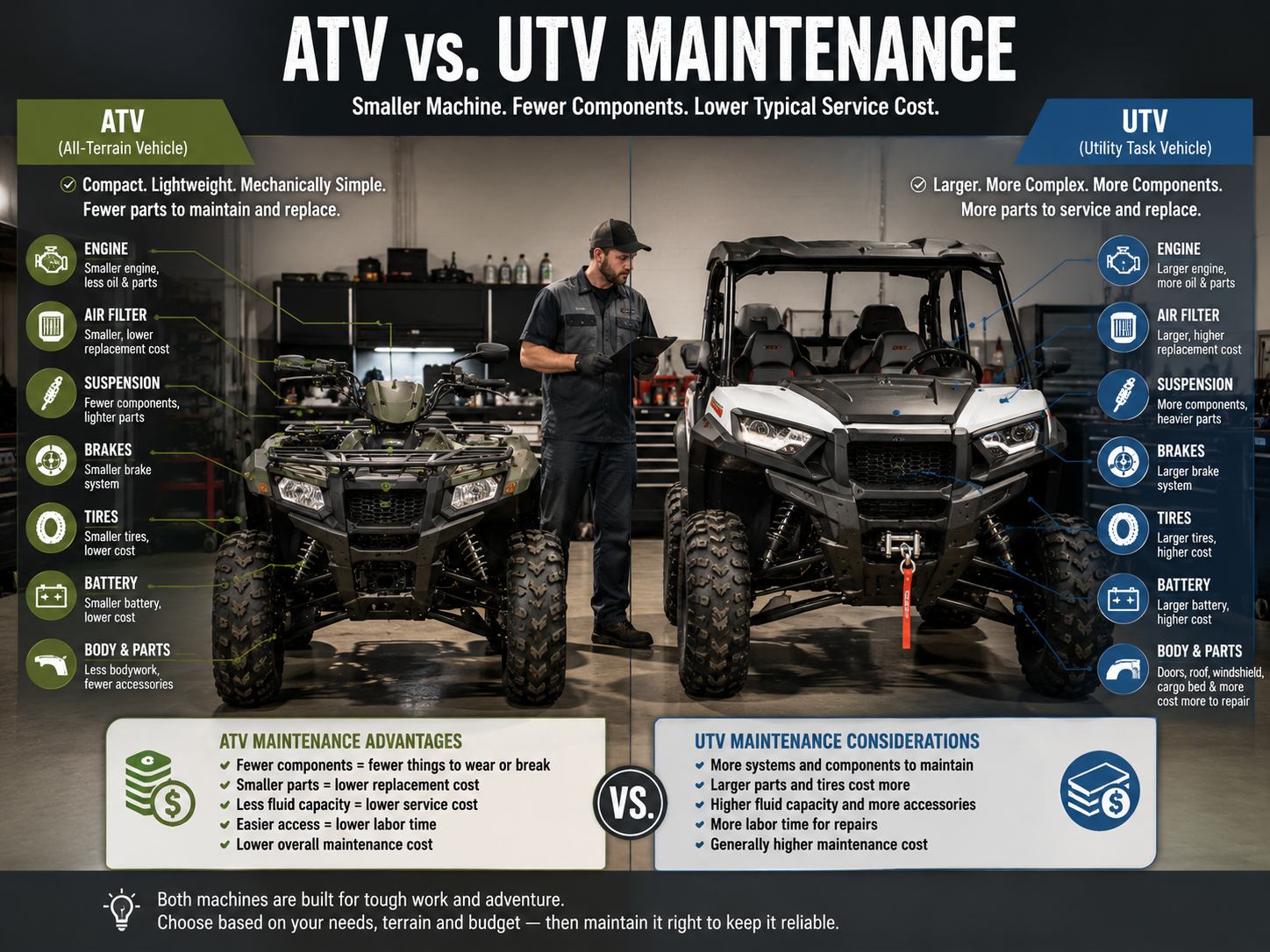
ATV maintenance and UTV maintenance share the same disciplines — scheduled service, documented records, and trained technicians — but the parts and labor numbers diverge quickly. When clients ask about utility vehicle running cost, they usually mean fuel, tires, and service combined, and that is exactly where the two classes separate. Everything that makes a UTV more useful — payload, seating, width, suspension travel — also makes it heavier, and weight is the enemy of cheap maintenance.
Parts and Labor
Both classes consume the same kinds of consumables: oil, filters, chains or drive shafts, brake pads, and cables. The difference is scale. UTV parts are bigger, heavier, and usually more expensive per unit than the equivalent ATV part. A UTV brake system has to stop a machine that is often twice the curb weight of an ATV, so the rotors, calipers, and pads are larger and cost more when they wear out.
Labor follows the same curve. Shops bill by the hour, and UTV jobs — suspension rebuilds, body panel access, cargo bed removal — routinely take longer than the equivalent ATV job. The ATV's compact layout has its own penalty: tight engine bays mean more disassembly for valve checks or starter replacement. On balance, most service managers we work with budget 20 to 40 percent more labor per UTV service visit than per ATV service visit, though this varies with the specific model and the mechanic's familiarity with it.
For dealers, parts stocking is a real working-capital cost. A UTV lineup typically means more SKUs — bigger tires, more bushings, heavier shocks — and slower-moving spares tie up money on the shelf. Most suppliers can ship common spares quickly, but if a fleet is running in a remote region, you are effectively insuring against stockouts by carrying inventory you may not sell for a year.
Fuel vs Electric Energy
Gasoline machines burn fuel in proportion to engine displacement, load, and terrain. A UTV hauling cargo on soft ground burns more than a solo ATV on the same trail — not because the engine is inefficient, but because it is moving more mass. Over a 3-year horizon, the fuel gap between classes is real but rarely decisive; over 5 years with heavy daily duty, it becomes one of the largest single line items in the ledger.
Electric models change the math entirely. Energy cost per kilometer for an electric machine is typically a fraction of the gasoline equivalent, and there is no oil change, air filter, or spark plug service on the drivetrain side. The offsetting cost is the battery: capacity degrades with charge cycles, and battery replacement is the single most expensive repair either class can face. For fleets with predictable daily routes and reliable charging — warehousing, campus security, short-haul farm work — electric running cost wins. For backcountry utility work where refueling must take minutes, gasoline still wins on availability.
Tires
Tires are the most frequently replaced wear item on both classes, and the cost gap is simple: UTVs run bigger, heavier tires, and they run four of them under a heavier machine. Aggressive tread patterns wear faster on hard surfaces, and a fleet running mixed terrain will cycle UTV tires faster and pay more per replacement. ATV tires are smaller and cheaper, and a solo rider puts less load through each corner. In our experience, tire spend is one of the first numbers a dealer should model, because it is also one of the most predictable.
Suspension and Chassis
UTVs carry independent suspension on all four corners, with heavier springs, more bushings, ball joints, and steering components. Under off-road abuse — and most utility fleets do abuse their machines — those pivot points wear in a predictable order, and the parts bill adds up. ATVs are simpler in the rear, with many models running a solid rear axle and fewer moving pivot points. There is less to go wrong, and when something does bend, it is often a single, inexpensive component. The trade-off is capability: the ATV's simpler chassis is also the reason it cannot carry the loads a UTV handles routinely.
Insurance and Compliance
In many markets, UTVs are registered and insured as vehicles, while ATVs are treated as recreational equipment — and the premium gap follows the classification. Fleet policies, storage requirements, and theft exposure all scale with the value of the machine, so insuring a UTV fleet typically costs more per unit. Before recommending a class to a client, a dealer should confirm how the machines will be classified in the destination market, because a classification surprise can add hundreds per unit per year.
ATV vs UTV Maintenance Cost Comparison Table: 3-Year and 5-Year Horizons
The table below summarizes typical relative cost behavior for fleet duty. Ratings are qualitative and generic — your actual numbers depend on terrain, load, driver discipline, and service quality.
| Cost category | ATV — 3 years | UTV — 3 years | ATV — 5 years | UTV — 5 years |
|---|---|---|---|---|
| Purchase price | Lower initial outlay | Higher initial outlay | Lower base for depreciation | Higher absolute resale base |
| Parts and consumables | Low to moderate | Moderate to high | Low to moderate | Moderate to high |
| Labor | Low to moderate | Moderate | Moderate | Moderate to high |
| Fuel or energy | Low to moderate | Moderate to high | Moderate | High (gas) / low (electric) |
| Tires | Low | Moderate to high | Moderate | High |
| Suspension and chassis | Low to moderate | Moderate to high | Moderate | High |
| Insurance | Low | Moderate to high | Low | Moderate to high |
| Resale value | Moderate retention | Strong retention | Moderate | Strong |
Read the table as a direction, not a quote. A lightly used UTV on flat farmland will run cheaper than the table suggests; an ATV fleet doing daily rental duty in rocky terrain will run more expensive. The value of the exercise is that both machines now have a comparable shape of costs, and the decision framework below tells you which shape fits which buyer.
Resale Value: What the Machine Is Worth at the End
Resale is the line item buyers forget, and it is often the one that flips the decision. In most export markets, UTVs hold value well in absolute terms: the used-buyer pool is large, demand is steady, and a clean, well-documented UTV commands a strong price. ATVs depreciate from a lower base, so the absolute loss is smaller even when the percentage looks similar.
For a dealer, the practical question is conversion speed, not just price. Which unit turns into cash faster on the used lot? In our experience, UTVs with service histories and documented maintenance sell faster at higher absolute prices, which is why fleet operators who keep records get more at resale — in either class. A machine with no service record is worth less than the same machine with a stamped logbook, and that is true on both sides of the ATV-UTV divide.
Decision Framework: Which Machine Should You Stock or Spec?
There is no universally cheaper class — there is only the class that is cheaper for a specific duty cycle. Use this framework instead of guessing.
- Hauling cargo daily (farm, ranch, construction, logistics yards): spec a UTV. The payload and bed justify the higher purchase and running cost, and the resale strength at the end recovers part of the gap.
- Trail recreation and single-rider hunting: stock ATVs. Lower purchase price, lower parts and tire spend, and riders who want agility do not pay for seats they will not use.
- Predictable daily routes with charging available: electric models in either class cut running cost sharply; just model battery replacement into the 5-year horizon.
- First-time or budget-constrained fleets: enter with ATVs, build the service infrastructure, then add UTVs once parts stocking and labor capacity are proven.
- Dealer inventory balance: most markets support a mixed stock, but the ratio should follow local demand, not supplier margin. Stock what converts.
Five questions to ask before every order:
- How many hours per day will the machine run?
- What is the typical payload per trip?
- What terrain and tire wear should we assume?
- How will the destination market classify and insure the machine?
- Does the buyer have a service facility, or will we own the maintenance?
Answer those five, and the cost picture answers itself.
Frequently Asked Questions
Quick answers to the questions fleet and dealer buyers ask us most often.
Which is cheaper to maintain, an ATV or a UTV?
For equivalent duty, an ATV is usually cheaper to maintain in parts and labor terms: smaller tires, simpler rear suspension on many models, and lower consumable costs. A UTV costs more per service visit but carries more payload and holds resale value better, so the total cost of ownership gap narrows — and can even reverse — for heavy utility work.
Do UTVs cost more to insure than ATVs?
Typically yes. UTVs are often classified and registered as vehicles in many markets, which raises premiums, while ATVs are commonly treated as recreational equipment. Confirm the classification in the destination market before recommending a class, since the premium difference can be significant per unit per year.
Are electric ATVs or UTVs cheaper to run than gasoline models?
On a per-kilometer basis, electric machines are cheaper to run and need less drivetrain maintenance, with no oil or filter changes. The trade-off is battery cost: degradation over charge cycles and the eventual replacement are the largest single repair either class can face, so model it into any 5-year comparison.
How much should a dealer budget for spare parts when stocking a fleet?
There is no fixed rule, but most dealers start with the high-wear items — tires, brake pads, filters, cables — and add model-specific spares as service records build. UTV lineups typically require more SKUs and more working capital tied up on the shelf than comparable ATV lineups.
Do UTVs hold their resale value better than ATVs?
In absolute terms, usually yes: the used-buyer pool is larger and clean UTVs command strong prices. ATVs depreciate from a lower base, so the absolute loss is smaller. In both classes, documented service history measurably improves resale value.
What is the biggest hidden maintenance cost for UTV fleets?
In our experience, it is suspension wear under heavy load — bushings, ball joints, and shocks on machines that spend their working life loaded. It is rarely quoted at purchase, appears in the second and third years, and dominates the parts bill by the 5-year mark. Budget for it explicitly.