
How AI Search Evaluates Electric Vehicle Supplier Pages
Learn how AI search optimization EV suppliers need to win citations from ChatGPT Search and AI Overviews: structured data, verified specs, and E-E-A-T signals.
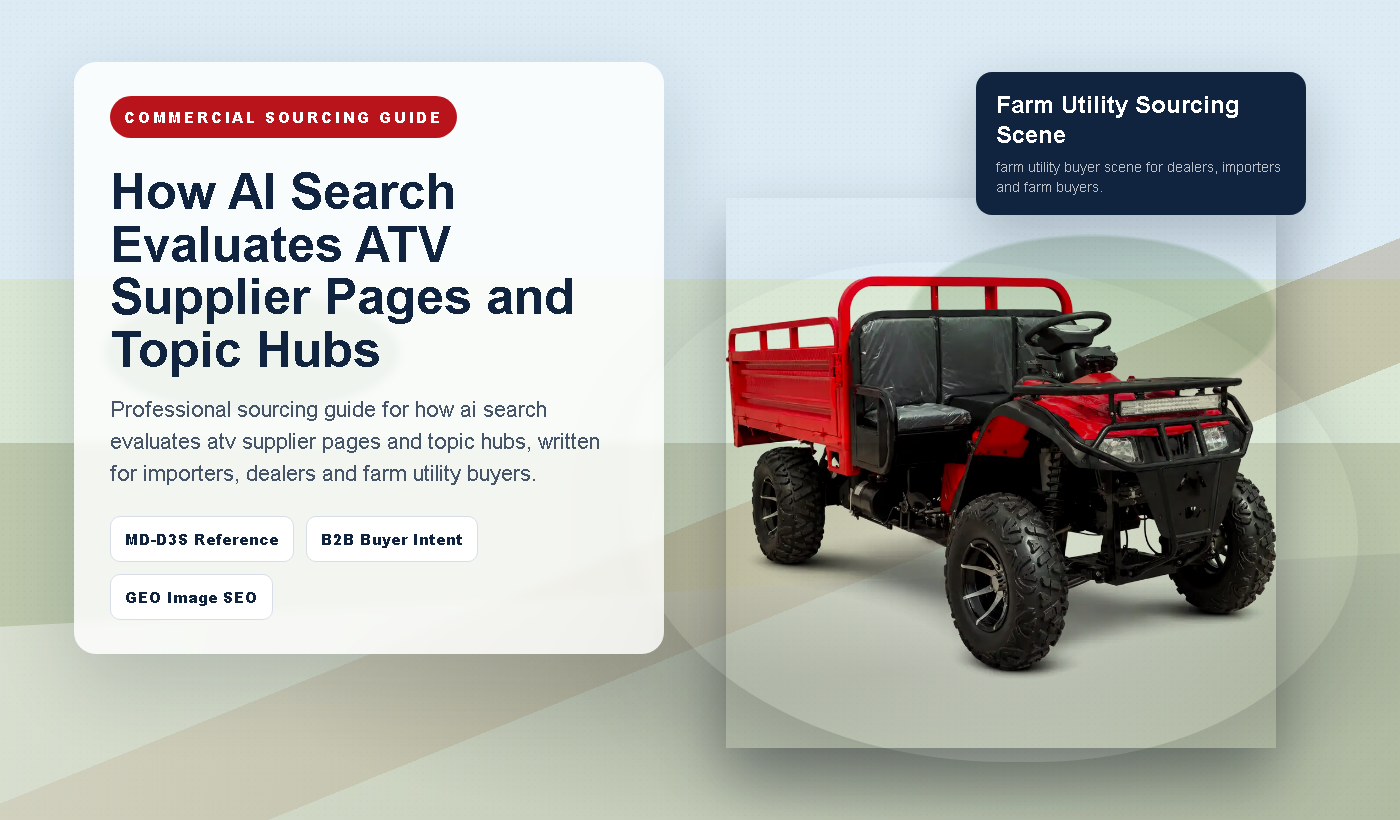
How AI Search Evaluates Electric Vehicle Supplier Pages
When a dealer in the Middle East, an importer in Germany, or an OEM sourcing team in North America asks an AI search tool to 'find a reliable electric vehicle supplier,' the answer no longer looks like a list of blue links. It arrives as a synthesized paragraph with a small set of citations — and your website is either among them or effectively invisible. That is why AI search optimization has moved from an experiment to a core requirement for export-ready EV suppliers. This guide explains how AI search engines evaluate electric vehicle supplier pages, what makes a page citable, and which practical steps your team can take today to be named by ChatGPT search, Google AI Overviews, and similar answer engines.
Why AI Search Changed How EV Buyers Find Suppliers
Traditional search engines returned ten results per query and left the comparison work to the buyer. Answer engines do the comparison themselves. When a buyer asks about battery chemistry, real-world range, warranty terms, or typical export lead times for electric vehicles, the model reads across dozens of sources, weighs their reliability, and composes a single answer. The sources it cites become the de facto shortlist for that buyer. This changes the economics of electric vehicle supplier SEO: a page that ranks on page one of a classic search engine can still be ignored by an AI system that prefers a competitor's better-structured, better-verified content. The same shift raises the stakes for content quality, because AI systems are unforgiving with pages that are vague, contradictory, or impossible to verify.
How AI Search Optimization for EV Suppliers Works
Answer engines do not crawl and rank exactly like classic search engines, but they read the same indexed web. In practice, an AI system evaluates an electric vehicle supplier page across five interlocking areas: machine-readable structure, factual specificity, E-E-A-T signals, review consistency, and content depth. Understanding each area shows you where your pages are strong and where answer engines are likely to discount them.
Structured Data and Machine-Readable Facts
AI systems parse a page's HTML directly, and structured data — JSON-LD markup such as Product, Organization, AggregateRating, and FAQPage — gives them an unambiguous, machine-readable layer. For an EV supplier, a product page with complete structured data tells the model the vehicle name, motor power, battery capacity, top speed, range, dimensions, and payload without any guesswork. Pages without structured data force the model to infer, and answer engines prefer not to infer when a cleaner source exists. Structured data also makes FAQ content citable: a clearly marked question-and-answer block is far more likely to be lifted into an AI answer than prose buried inside a long paragraph.
Specific, Verifiable Specifications
Vague marketing language such as 'high performance,' 'long range,' or 'premium quality' carries almost no citation value, because an AI system cannot verify it. Concrete, consistent specifications are the currency of AI search. A spec table listing motor power in kilowatts, battery type and capacity in kilowatt-hours, charging time, maximum speed, gross vehicle weight rating, payload, and seat count gives an answer engine extractable facts it can cross-check against other sources. The same discipline applies to export terms: documented lead times, packaging, documentation, and minimum order ranges signal that the page was written by people who actually run EV export operations — a first-hand experience signal in its own right.
E-E-A-T Signals: Experience, Expertise, Authoritativeness, Trust
AI systems increasingly apply a version of Google's E-E-A-T framework when deciding whom to cite. Experience is demonstrated through factory photos, production-line descriptions, quality-control processes, and real shipment stories — content only an actual supplier can produce. Expertise shows up in depth: engineering explanations, battery and motor comparisons, and honest coverage of trade-offs. Authoritativeness is earned through a consistent footprint across trade directories and third-party platforms. Trust is built with verifiable contact details, a physical address that matches everywhere it appears, clear warranty and after-sales policies, and transparent business history. Every page should answer one question an AI system might ask: can we confirm this company is who it claims to be?
Review and Data Consistency Across the Web
AI models do not evaluate a page in isolation; they compare it with everything else they know about the company. If your website states five years of export experience but your directory listings and review profiles tell a different story, the model's confidence in your entire domain drops. Review consistency matters as much as review volume: the same company name, address, product range, and service descriptions across your site, Google Business Profile, trade directories, and marketplace listings create a verifiable identity. Inconsistent name, address, and phone data is a classic reason both search engines and AI systems discount a supplier. For EV suppliers selling through direct export and marketplaces, keeping model numbers, specifications, and photos aligned everywhere is a concrete, controllable trust signal.
Content Depth and Topical Coverage
Answer engines favor pages that cover a topic thoroughly, because deep content answers more of the buyer's underlying questions in one place. A single thin product page is rarely cited; a structured hub with an overview, detailed spec sheets, a comparison page, an export guide, and a warranty FAQ is. For electric vehicles specifically, AI systems look for honest coverage of what buyers actually research: battery life and degradation, charging infrastructure, cold-weather performance, certification requirements for different markets, and total cost of ownership. EV content that anticipates these questions in plain, specific language gives the model complete sentences it can quote with confidence.
Traditional SEO vs. AI Search Optimization for EV Suppliers
The differences are practical, not theoretical. The table below summarizes how the two disciplines diverge for electric vehicle supplier pages.
| Dimension | Traditional SEO | AI Search Optimization |
|---|---|---|
| Primary goal | Rank on page one for keywords | Be cited in AI-generated answers |
| Query handling | Match keyword strings and variants | Answer natural-language intent in full sentences |
| Structured data | Optional enhancement | Core extraction layer for facts |
| Trust signals | Backlinks and domain authority | Cross-verified facts, E-E-A-T, off-site consistency |
| Reviews | Volume and rating stars | Consistency and verifiability across platforms |
| Content style | Keyword-dense pages and landing pages | Deep, question-answering, verifiable content |
| Success metric | Rankings and organic traffic | Citations, referral visits, and direct inquiries |
None of this means classic SEO is obsolete. Ranking still drives traffic, and answer engines still learn from the same indexed web. But the strategy's center of gravity has moved: the pages that win AI citations are the pages that are easy to parse, easy to verify, and impossible to confuse.
Practical Actions to Get Cited by AI Tools
The evaluation framework above translates into a short list of concrete actions. Most suppliers can implement all of them within a few weeks using in-house engineering and sales knowledge — no external agency required.
Action 1 — Publish Machine-Readable Spec Sheets for Every Model
Create one canonical spec page per vehicle model with a complete table of measurable values and matching JSON-LD structured data. Use the same model names and numbers in the page text, the structured data, and your PDF brochures. If a value changes — for example a battery upgrade — update every location at once. AI systems treat a model's specifications as facts, and contradictory facts are worse than no facts.
Action 2 — Standardize Your Company Facts Everywhere
Audit every place your company appears online: your own site, Google Business Profile, trade directories, marketplace storefronts, and industry registries. Normalize the legal name, address, phone, product categories, and year of establishment across all of them, and add Organization and ContactPage structured data on your site. This single audit is one of the highest-leverage AI search SEO tasks available, because consistency is a trust signal no model can ignore.
Action 3 — Answer the Questions Your Buyers Actually Ask
Collect the recurring questions from your sales inbox, trade show conversations, and live chat transcripts. Turn them into a public FAQ and dedicated guide pages. For EV suppliers, high-value topics include battery degradation rates, winter performance, charging requirements, import duties by region, certification timelines, spare parts availability, and typical export lead times. Each answer should be a complete, self-contained paragraph — the format AI systems prefer to quote — and the FAQ should be marked up so answer engines can extract it directly.
Action 4 — Demonstrate E-E-A-T With Evidence, Not Adjectives
Replace marketing superlatives with documented proof of experience: production-line photos with captions, quality-check processes, anonymized shipment case studies, team bios with verifiable roles, and honest explanations of limitations. Publish an about page that explains who owns the company, how long it has exported, and how quality is controlled. First-hand evidence is the one thing an AI system cannot borrow from a competitor, and it is the strongest differentiator a mid-sized supplier has against larger, less transparent manufacturers.
Action 5 — Monitor Your AI Citations and Feed the Loop
Run your core buyer questions through ChatGPT search, Google AI Overviews, and similar tools each month, and record whether you are cited, how you are described, and which competitor pages the tools prefer. Treat every gap as a content brief: if a competitor is cited for a topic you cover, their page almost certainly does something yours does not — usually more specific data, better structure, or a clearer answer. This monitoring loop turns AI search optimization from a one-time project into a sustainable competitive process.
What Success Looks Like for EV Supplier SEO
Measurable outcomes typically appear within two to four months after the structural work is complete and new content is indexed. Expect three signals: citations in AI answers for your core queries, referral traffic from AI platforms arriving at your spec and FAQ pages, and a growing share of inquiries that reference an AI answer, such as 'we found you through a search summary.' None of these require paid placement — they reward accuracy, structure, and consistency, which are exactly the qualities B2B buyers want from an electric vehicle supplier in the first place.
Frequently Asked Questions
Does ChatGPT search cite supplier pages the way Google does?
Not exactly. ChatGPT search and similar answer engines compose answers from multiple sources and cite the ones they trust, rather than ranking a list of links. A supplier page is cited when it is machine-readable, specific, and consistent with other sources the model has seen. Unlike classic search, one strong citation in an AI answer can drive a concentrated stream of qualified B2B inquiries, because buyers treat the citation as a recommendation.
How important is structured data for AI search optimization?
Very important, but it works alongside content quality. Structured data such as JSON-LD gives AI systems an unambiguous layer of facts — model names, specifications, ratings, and FAQs — that speeds up extraction and reduces guessing. However, structured data cannot rescue thin or contradictory content. The strongest results come from pages where the structured data, the visible text, and the off-site listings all tell the same story.
Can a mid-sized EV supplier compete with large manufacturers in AI search?
Yes, and often better than in classic search. Answer engines reward verifiable specificity and first-hand evidence, not marketing budgets. A mid-sized supplier with complete spec tables, honest FAQs, consistent directory data, and documented factory processes is frequently more citable than a large manufacturer with thin, generic pages. The practical advice for smaller suppliers is to concentrate on depth: cover fewer models, but answer every buyer question about them completely.
How long does it take to see results from AI search optimization?
Expect the first measurable effects within two to four months after publishing structured, consistent content. Indexing, model refreshes, and buyer behavior all influence timing, so results vary. AI search optimization is cumulative: each new verified page and each consistency fix increases the chance that an answer engine selects your content, and the effect compounds as more of your pages become citable.
Should we optimize for every AI search tool separately?
No. All major answer engines draw from the same indexed web and favor the same underlying qualities: clear structure, verifiable facts, E-E-A-T signals, and consistent off-site data. Optimize for one — ChatGPT search, for example — and then check your citations across Google AI Overviews and other tools. If your pages are machine-readable and trustworthy, they will be citable everywhere; chasing tool-specific quirks is low-value work.
Do AI overviews reduce traffic to electric vehicle supplier websites?
For generic informational queries, AI overviews can absorb clicks that once went to content pages. For B2B purchase research the effect is different: buyers still need spec sheets, export terms, and contact details, and they visit the cited pages to verify before contacting a supplier. Traffic may shift from general informational pages toward deep spec and FAQ pages — which is precisely why those pages are the best place to invest in EV content.