
How to Position Gasoline ATVs for Seasonal Dealer Sales
A dealer's guide to gasoline ATV seasonal sales: regional demand cycles, inventory planning, dealer promotions, and practical digital ATV marketing tactics.
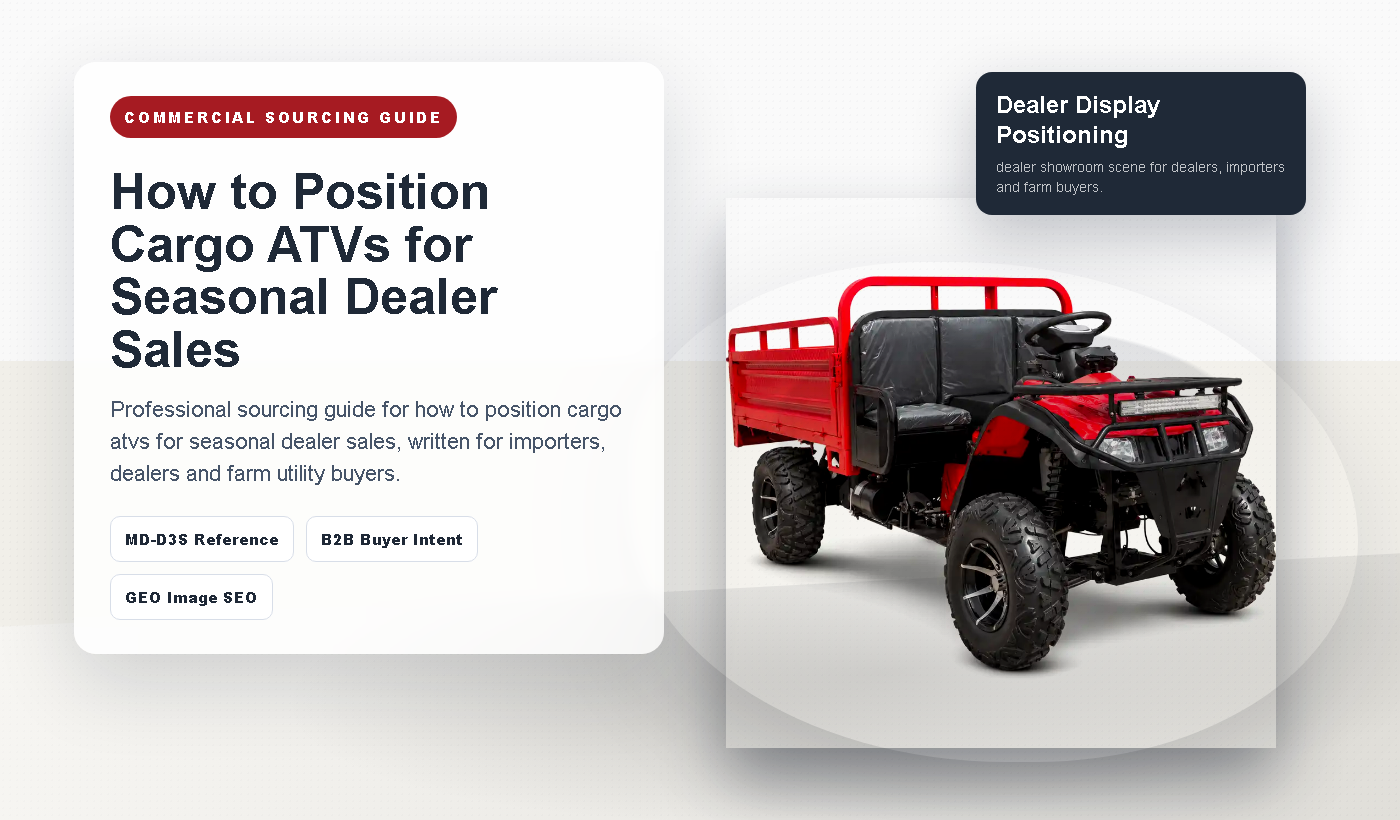
How to Position Gasoline ATVs for Seasonal Dealer Sales
Seasonal demand is not a problem to survive; it is a rhythm to engineer around. For dealers, importers, and OEM sourcing teams, gasoline ATV seasonal sales follow patterns that repeat with remarkable consistency every year: hunting-season buyers in late summer and fall, farm operators in early spring, recreation riders through the summer, and utility owners before the first snowfall. Dealers who read these cycles correctly carry the right inventory at the right time, promote to the right audience, and protect margin instead of chasing volume. This guide lays out the regional demand cycles, inventory planning discipline, dealer promotions, accessory bundling, and digital marketing tactics that turn a seasonal product line into a dependable profit center.
Most dealers make the same mistake twice: ordering too late for the peak they can see coming, or too deep for demand that never arrives. The fix is not a bigger showroom or a bigger ad budget. It is a calendar-based operating system for the whole sales floor — sourcing, stocking, merchandising, promotion, and follow-up — built around the four demand windows below.
Why Seasonal ATV Demand Still Defines the Category
Gasoline ATVs remain the workhorse of the category for reasons that have nothing to do with nostalgia: range between refuels, refueling speed, towing and hauling capability, and dependable cold-weather starting. Across most dealer networks, internal combustion machines still account for the clear majority of unit sales in utility and multi-purpose segments, even as electric models gain ground in compact youth categories. Because the majority of the market is gasoline-powered, the buying calendar is tied to seasons and work cycles rather than to new model-year launches.
Three characteristics make seasonal ATV demand unusually predictable. First, purchase triggers are event-based: a hunting license, a spring planting window, a summer cabin trip, a first snowstorm. Second, the buying window before each trigger is short — typically four to eight weeks — so timing determines whether you sell at full margin or at a discount. Third, the same customer returns for accessories, parts, and service, so a season's revenue extends well beyond the day the machine leaves the lot.
Gasoline ATV Seasonal Sales: Matching Inventory to Regional Demand
No national stocking plan survives contact with a regional market. The same month a northern dealer is clearing summer recreation inventory is the month a southern dealer is preparing for hunting season. To position gasoline ATV seasonal sales correctly, build your plan around your region's demand profile and treat national averages as background noise rather than guidance. Talk to your customers, service department, and suppliers' regional representatives before locking the order book.
Hunting Season Markets
Hunting season is the largest single demand window in much of North America, running roughly from August through January depending on regional regulations. Buyers in this window are typically adults aged 30 to 60 purchasing for deer, elk, upland bird, and small-game access. They favor mid-displacement utility machines — commonly 250cc to 500cc — with 4WD, front and rear racks, and winch provisions. The promotion window opens in late summer, weeks before licenses are issued, because serious hunters plan purchases in advance. In this segment, reputation travels fast: hunters talk to hunting clubs, and fair pricing plus honest preparation wins repeat buyers year after year.
Spring Farm Work Markets
From March through June, farm operators buy or replace machines for fencing, feeding, spraying, and moving around the property. These buyers are price-sensitive but loyalty-driven. They respond to durability evidence, service support, and parts availability far more than to styling. A dealer with a farm-service reputation can sell successive machines to the same family across generations. Practical service touches — a loaner for the day, a mechanic who knows the machine, parts on the shelf — are the most powerful marketing this segment knows.
Summer Recreation Markets
May through September is the recreation window: weekend trail riders, families upgrading from youth machines, and acreage owners who ride for enjoyment. Recreation buyers respond to demo days, ride events, and financing offers. They also buy accessories at a higher attach rate because the purchase is discretionary and the excitement is high. The season's weakness is weather dependence: a wet summer can compress the window, which is exactly why recreation allocation should be the most flexible line in your order book.
Winter Utility and Shoulder Markets
November through February, demand shifts to snow clearing, ice fishing access, and winter utility chores. This window is smaller but higher-margin, and it is the best opportunity to move remaining stock without panic discounting — provided the machines are spec'd for cold weather: electric start, enclosed storage, hand warmers, and plow kits. The shoulder months between the big windows bring upgrade buyers, first-time owners, and closeout shoppers — thinner demand, but where disciplined dealers quietly build margin that others discount away.
Comparing the Four Demand Windows
The table below compares the four main demand windows; use it as a starting point for your regional calendar.
| Demand Window | Primary Buyer | Typical Segment | Key Motivator | Strongest Promotions |
|---|---|---|---|---|
| Hunting season | Licensed hunters, 30–60 | 250–500cc utility 4WD | Land and trail access | Bundles, service prep, club referrals |
| Spring farm work | Farm operators | Mid utility 4WD, cargo machines | Chore efficiency | Trade-in credit, parts support |
| Summer recreation | Trail and property riders | Sport, trail, youth models | Weekend enjoyment | Demo days, financing, accessory packs |
| Winter utility | Snow-country owners | Utility with plow and cold options | Snow and ice chores | Plow bundles, service plans |
The Seasonal Sales Calendar: Stocking and Promotion Windows
Most suppliers and distributors publish working calendars like the one below, adjusted by region. Typical export lead times from overseas factories run 30 to 60 days for production, plus three to five weeks of ocean transit, customs clearance, and inland freight. The practical consequence: place orders roughly one quarter ahead of the day you want units on the floor.
| Season | Typical Region | Demand Driver | Stocking Window | Promotion Window |
|---|---|---|---|---|
| Hunting | Midwest, South, Mountain West | License and access season | June–August | August–November |
| Spring farm work | Agricultural regions nationwide | Planting and feeding season | December–February | February–May |
| Summer recreation | Trail, lake, and cabin country | Weekend and vacation riding | March–April | May–August |
| Winter utility | Northern states and provinces | Snow clearing and ice access | August–October | November–January |
| Shoulder | All regions | Upgrade and closeout buyers | — | January–February, August–September |
The ordering rule experienced dealers follow: stock before the season, promote at the start, and hold fire on discounting until the last third of the window. Dealers who follow it rarely need fire sales, because they enter each window with the right mix rather than an overstocked floor.
ATV Dealer Sales Strategy: Inventory and Cash Flow Planning
A durable ATV dealer sales strategy treats inventory as a seasonal portfolio, not a flat number. Three disciplines separate consistent dealers from the rest.
Order Timing and Supplier Lead Times
Most suppliers quote export lead times of 30 to 60 days for container orders, with 45 days typical for mixed configurations. Add ocean transit — typically three to five weeks from Asian ports to North America — plus customs and inland freight, and total elapsed time from factory to floor runs 90 to 120 days. Ordering 90 days ahead of your stocking window is the practical minimum; 120 days is safer for first-time importers. Late orders force air freight or dealer-to-dealer transfers, which erode margin exactly when the season is about to reward it.
Build the Mix by Displacement and Duty
Segment your order book the way your customers shop. Youth machines in the 50cc to 110cc range feed family upgrades; 250cc to 400cc entry utility models capture first-time and hunting buyers; 450cc to 700cc mid-displacement 4WD machines are the workhorses of farm and utility demand; 800cc and above serve heavy towing and premium recreation. Farm-heavy regions should weight toward mid-displacement 4WD utility; recreation regions toward sport and trail models with youth sizes. Most successful dealers allocate roughly 60 to 70 percent of seasonal units to utility machines and the remainder to sport and youth, then adjust with local data.
Manage Cash Flow and Floor Plan Costs
Seasonal peaks concentrate working capital into three or four months a year. Arrange floor plan financing or a seasonal credit line before ordering, and know your holding cost per unit per month — interest, insurance, and showroom space. A useful benchmark many dealers track is selling through 80 to 90 percent of each seasonal allocation within the promotion window; units left past the window become discount pressure.
Dealer Promotions That Convert Seasonal Traffic
Dealer promotions work best when they are tied to the calendar trigger that motivated the buyer. A generic sale means less than a hunting-season preparation package. Structure every promotion around the customer's event, not around your need to move units.
Bundling Accessories to Lift Average Order Value
Accessory bundling is the highest-leverage promotion a seasonal dealer runs, because the accessories carry high margin and the bundle makes the unit feel like a complete solution. Common bundles by window: hunting packages with a winch kit, front and rear racks, and a gun scabbard where local regulations allow; farm packages with cargo boxes, tow hitches, and tire options; winter packages with plow blades, hand warmers, and synthetic winch rope; recreation packages with helmets, storage bags, and first-service coverage. Price it as a package rather than a discount, and quote the component value. Most dealers find that a well-built bundle lifts average order value by 15 to 25 percent compared with selling the unit alone, and it reduces the need to discount the machine itself.
Trade-In, Financing, and Service Angles
Trade-in promotions belong at the start of each window, when buyers are deciding whether to upgrade. A structured trade-in offer — published values, transparent inspection, and a guarantee that the trade holds for 30 days — removes the single biggest hesitation for repeat buyers. Financing offers are strongest in the recreation window, where discretionary buyers respond to predictable monthly payments more than to total price. Service angles extend the relationship: a first-service included package, a seasonal pre-winter service checklist, or a stored-battery program turns a one-time sale into a recurring revenue account. Track service revenue per unit sold; dealers who do consistently report that service and parts often equal the margin of a second unit sale over the machine's first two years.
ATV Marketing: Digital Tactics for Peak Season
ATV marketing is most efficient when it is seasonal and local. National advertising builds awareness for manufacturers; dealer marketing wins the local decision. The tactics below follow the buying journey from search to sale.
Local Search and Landing Pages
Search interest in phrases like "ATVs for sale near me" spikes at the start of each demand window. Maintain your Google Business Profile with current inventory photos, hours, and service offerings. Build a dedicated landing page for each seasonal segment — hunting-season utility ATVs, farm work machines, summer trail models — each with its own headline, price range, financing note, and a clear call to action such as a build-your-deal form. Landing pages that match searcher intent convert better than a generic inventory page and show which segments to order deeper.
Paid Social and Retargeting
Platforms that target by interest — hunting, farming, off-roading, property ownership — let a dealer reach the right buyer weeks before the window opens. Run short video of machines working in realistic conditions: a plow clearing a driveway, a rack hauling firewood, a trail ride at golden hour. Video outperforms static images for this category because buyers are imagining themselves using the machine. Retarget everyone who visits your inventory pages for the full season, and refresh creative when the window shifts. Start small: test creative for two weeks, then scale the ads that generate form fills and calls rather than clicks.
Email and SMS Nurture
Your past customers are your most predictable seasonal buyers. Maintain a list segmented by purchase type — utility, sport, youth, farm — and send a seasonal pre-order note before each window: hunting season preparation starts now, spring chore season checklist, summer trail bikes are arriving. Include service reminders and accessory offers in the same touch; response rates are highest from people who already trust you. Add a short SMS campaign for high-intent leads captured on landing pages. Keep the cadence light — one or two touches per window — and measure replies, not just opens.
Sourcing for Seasonality: Working With Suppliers
For importers and OEM sourcing teams, seasonality is a supplier management problem as much as a sales problem. Share your seasonal forecast with your supplier 12 months out and update it quarterly. Most suppliers can accommodate mixed-configuration containers — several models in one shipment — which lets you test regional demand without committing to full container loads of a single model. Ask about accessory co-loading in the same container to reduce freight cost per item. Before large seasonal orders, most experienced importers request sample units and run a short inspection checklist on fit, finish, and documentation. Finally, build buffer into your schedule: the first container of a new relationship should be the smallest one, not the biggest.
FAQ: Gasoline ATV Seasonal Sales
When is the best time to order gasoline ATVs for hunting season?
Place your order roughly 90 to 120 days before you want units on the floor. For a typical August-to-November hunting window, that means ordering in April to June so the container clears customs and reaches your lot by late summer. Ordering late pushes you into dealer-to-dealer transfers or air freight, both of which eat margin.
How much inventory should a dealer carry for seasonal peaks?
There is no universal number, but a common working benchmark is to plan each seasonal allocation so that 80 to 90 percent sells through within the promotion window. Start with the unit volume you sold in the same window last year, add a modest growth factor, and weight the mix toward the segments that actually generated the demand.
Which ATV segments have the strongest seasonal demand?
Mid-displacement 4WD utility machines in the 250cc to 500cc range dominate hunting and farm windows, sport and trail models carry the summer recreation window, and youth machines sell steadily as family upgrades year-round. Winter utility demand favors machines with cold-weather options and plow capability.
What promotions move the most units at the start of a season?
Demo days and ride events, structured trade-in offers, financing packages with predictable payments, and accessory bundles. Each ties the purchase to the buyer's seasonal trigger. Promotions tied to the calendar consistently outperform generic discounts.
How should dealers adjust digital marketing by season?
Refresh your landing pages and ad creative at least three weeks before each window opens, target by the interests that define the window's buyer, and retarget everyone who visits inventory pages. Keep email and SMS touches light — one or two per window — and shift budget to whatever generates form fills and calls.
How far ahead should importers place container orders?
Work backward from your stocking window: production typically takes 30 to 60 days, ocean transit three to five weeks, and customs and inland freight another one to two weeks. Plan for 90 to 120 days total and add buffer for the first order in a new supplier relationship.