Gasoline ATV vs Four-Wheeler: What Is the Real Difference?
Gasoline ATV vs four-wheeler: the terms mean the same machine. Compare gas ATV engines, CVT vs manual, 2WD vs 4WD, and UTV differences for B2B buyers.
Gasoline ATV vs Four-Wheeler: What Is the Real Difference?
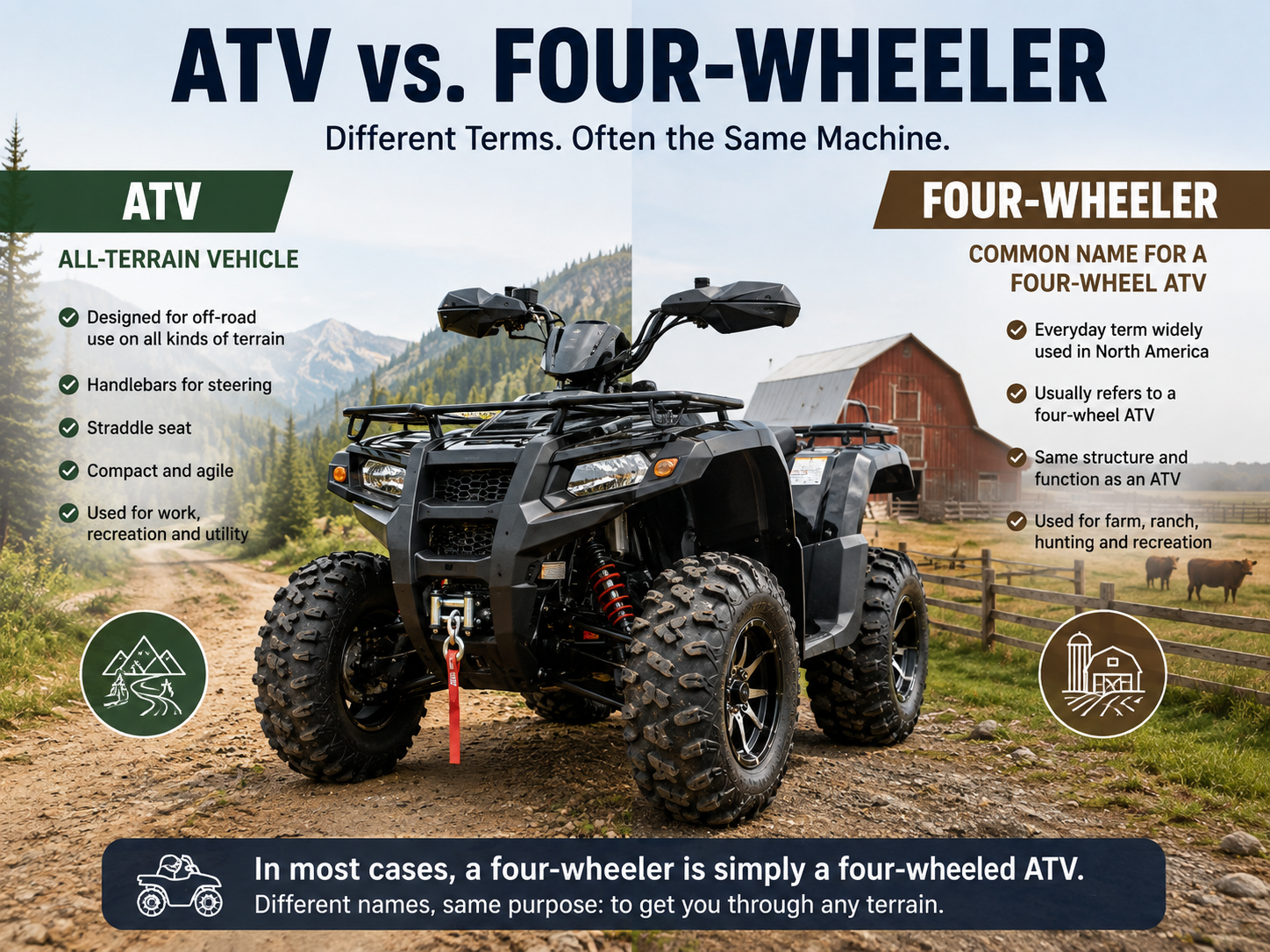
Gasoline ATV vs four-wheeler is one of the most searched questions in the powersports industry, and one of the most misunderstood. For importers, dealers, and OEM sourcing teams, the terminology matters less than the machine behind it: an ATV, a four-wheeler, a quad, and a quad bike all describe the same vehicle class. That class is a straddle-seat, handlebar-steered, four-wheeled off-road vehicle powered by an internal combustion engine. When you compare gas ATV models side by side, the real differences are not in the name. They are in displacement, transmission, drivetrain, build quality, and the work the machine is expected to do.
Gasoline ATV vs Four-Wheeler: Same Vehicle, Four Names
The confusion starts with marketing, not engineering. ATV stands for all-terrain vehicle, and it is the industry-standard term used in specifications, import documentation, and technical literature. Four-wheeler is the casual North American name that became popular in the 1980s and 1990s, when recreational machines spread beyond farms onto weekend trails. Quad is a short form of quadricycle, a term that dates back to early four-wheeled vehicles and remains common in advertising. Quad bike is the everyday name used in the United Kingdom, Australia, and New Zealand, where regulators often write it into law.
These ATV terms describe the same machine architecture. A typical gasoline four-wheeler has an engine mounted in the frame, four wheels with low-pressure tires, a straddle seat, handlebars for steering, and controls operated by hand or foot. There is no engineering difference between an ATV and a four-wheeler, and there is no performance difference between a quad and a quad bike. The only real variation is geography and habit.
Why the Terms Persist in Different Markets
Search behavior explains a lot. A buyer in the United States searching for a four wheeler for sale is looking for the same product as a buyer in Germany searching for a Quad and a buyer in Australia searching for a quad bike. Distributors that list inventory under one name only can lose visibility in regions where another name dominates. For this reason, most suppliers list the same machine under multiple keywords, and smart B2B buyers search all of them when comparing gas ATV options.
What to Write in Your RFQ
When you send a request for quotation, use ATV as the primary descriptor and add the synonyms in the notes. A line such as ATV, 250cc utility quad, also known as four-wheeler, removes ambiguity without forcing your supplier to guess. Most suppliers understand all four terms, but precise language reduces back-and-forth and makes it easier to compare offers across factories.
What a Gasoline ATV Is, and What It Is Not
A gasoline ATV is a single-rider or two-up (rider plus passenger) vehicle built for off-road work and recreation. It uses a petrol engine, so it is also commonly called a gas ATV or petrol ATV in catalogs. Fuel is stored in a tank, and the engine drives the wheels through a transmission. The design prioritizes maneuverability, low ground pressure, and the ability to climb, tow, and carry loads over rough terrain.
An ATV is not a UTV. A utility task vehicle, or side-by-side, has bench seats, a roll cage, and automotive-style controls, and it carries more cargo. That distinction matters for sourcing decisions, and it is covered in detail later in this article. For now, keep this rule in mind: if the rider straddles the seat and steers with handlebars, it is an ATV, regardless of what it is called locally.
Engine Size: The 125cc to 800cc Spectrum
Displacement is the first specification a B2B buyer should understand, because it drives price, capability, compliance, and running costs. Gas ATV engines in the export market range from small 110cc and 125cc units up to 800cc machines. The right size depends on rider weight, terrain, and workload, not on what looks impressive in a brochure.
| Displacement | Typical Output | Common Use | Buyer Notes |
|---|---|---|---|
| 110–125cc | 6–10 hp | Youth models, light farm duty, training fleets | Lowest entry price; suited to small riders; limited payload and hill climb |
| 150–250cc | 9–18 hp | Light utility work, ranch chores, adult beginners | The most popular import segment; best balance of price and capability |
| 300–400cc | 18–30 hp | Mid-range utility, towing, mixed terrain | Real work capacity; strong rental-fleet candidate |
| 450–500cc | 28–38 hp | Heavy utility, steep terrain, commercial sites | High torque and durable drivetrains; higher upkeep cost |
| 550–800cc | 38–55 hp | Touring, heavy towing, large-acreage operations | Premium segment; higher purchase price and fuel consumption |
Matching Displacement to Market Demand
Importers building a balanced stock typically order across three bands. Entry-level 125cc to 250cc machines capture price-sensitive buyers and youth riders. Mid-range 300cc to 400cc models are the workhorses of utility quad demand and hold resale value well. Large 500cc and above models serve niche buyers who need serious towing and hauling. Before committing to a container, review the terrain, the typical rider profile, and the local licensing rules in your destination market, because several countries restrict quad bike engine sizes for young riders.
Transmission: CVT or Manual Gearbox?
Modern gas ATVs come with two main transmission types, and the choice affects rider training, spare parts, and after-sales support.
The continuously variable transmission, or CVT, is the dominant type on today's four wheelers. It uses a belt-and-pulley system that changes ratio smoothly with engine speed, so there is no clutch lever and no shifting. A CVT is easy to learn, forgiving in mud and sand, and ideal for rental fleets where riders have varying experience. The main service items are the drive belt and the clutch weights, which most suppliers can ship as common spare parts.
Manual gearboxes are less common on new ATVs but still appear on smaller utility quads. They use a foot shifter, often with a hand clutch, and give the rider direct control on steep descents and technical trails. Manuals are slightly cheaper to build, which can lower the landed cost of entry-level machines, but they require more rider skill and more frequent clutch adjustment. For dealer networks serving beginners, CVT is usually the safer recommendation.
2WD vs 4WD: Choose the Drivetrain That Earns Its Keep
Two-wheel-drive ATVs drive through the rear wheels only. They are lighter, cheaper, and more fuel-efficient, and they are perfectly adequate for flat farm yards, dry trails, and light chores. Most 125cc to 250cc gas ATVs are two-wheel drive, which keeps entry pricing attractive.
Four-wheel-drive models send power to all four wheels and typically add a selector that lets the rider switch between 2WD and 4WD on the move. The extra traction pays for itself in mud, snow, sand, and steep slopes, and most 300cc and larger utility ATVs offer it as standard. Buyers should also check whether the front drive uses a solid axle or independent suspension, and whether a locking differential is available, because these details decide how the machine behaves in real terrain.
For a dealer, the practical rule is simple: 2WD covers the low end of the market, 4WD covers everyone who actually works the machine. A stock that mixes both gives customers a clear upgrade path instead of pushing them to another brand.
Where Gasoline ATVs Earn Money: Use Cases for B2B Buyers
Understanding the workload behind each order helps you forecast demand and choose configurations. The main commercial use cases for petrol ATVs are:
- Agriculture and farming: feeding livestock, moving feed, spraying, and towing trailers on medium to large properties.
- Hunting and ranching: quiet access to remote land, carrying gear, and retrieving game in rough country.
- Tourism and rentals: guided trail experiences and resort transport, where durable CVT machines with easy controls keep downtime low.
- Construction and facilities: site patrol, tool transport, and inspection on sites where full-size trucks cannot go.
- Forestry and utility support: line maintenance, trail upkeep, and fire-prevention patrols on managed land.
Each use case changes the spec sheet. Rental operators prioritize reliability, easy controls, and common spare parts. Farmers prioritize torque, towing capacity, and ground clearance. Site managers prioritize payload and service access. When a buyer can name the use case, a supplier can recommend a configuration with confidence.
Maintenance and Running Costs of a Gas ATV
A gasoline ATV is a simple machine, and its running costs are predictable if the service schedule is followed. The recurring cost items are fuel, engine oil, filters, tires, and the drive components. Generic industry guidance is to change engine oil and filter every 50 to 100 operating hours or once per season, whichever comes first, and to check the air filter after dusty work. CVT belts should be inspected at every service and replaced when glazed or cracked. Chain-driven models need periodic tensioning and lubrication; shaft-driven models need fluid checks but almost no adjustment.
Fuel consumption depends heavily on displacement and workload, but small 125cc to 250cc machines are typically very economical, while 500cc and larger models consume noticeably more. Tires are the largest wear item on rough terrain, so dealers should keep common sizes in stock. Winter storage adds one rule: drain or stabilize the fuel, and maintain the battery, before machines sit idle for months. Following these steps keeps warranty claims low and resale values high.
For dealers preparing new stock for sale, a simple pre-delivery routine protects both the machine and the relationship with the buyer:
- Check engine oil level and fill to specification before the first start.
- Inspect tire pressure and brake operation on all four wheels.
- Test the CVT engagement or the manual clutch action.
- Verify lights, switches, and safety labels are intact and legible.
- Run a short test ride and check for leaks, vibration, or abnormal noise.
Gas ATV vs UTV: The Comparison Buyers Actually Need
Buyers who are new to the sector often ask whether a UTV is simply a bigger four-wheeler. It is not. The two categories serve different buyers, and confusing them causes real sourcing mistakes.
| Feature | Gasoline ATV | UTV (Side-by-Side) |
|---|---|---|
| Seating | Straddle seat, rider plus optional passenger | Bench or bucket seats side by side |
| Steering | Handlebars | Steering wheel |
| Cargo | Racks on front and rear | Integrated cargo bed, higher payload |
| Occupant protection | None by design; rider control is key | Roll cage, seat belts, doors on many models |
| Best terrain | Narrow trails, tight work areas | Open ground, farm and site duties |
| Price position | Generally lower per unit | Generally higher per unit |
The distinction is not a judgment of quality; it is a question of fit. A dealer serving trail riders and hunters needs gas ATVs. A dealer serving construction and estate teams needs side-by-sides, and many successful operations stock both. When a customer asks for a utility quad, confirm whether they mean a 4x4 ATV with racks or a bed-carrying UTV, because the answer changes the order completely.
What to Verify Before You Source Gas ATVs in Volume
Terminology is only the first layer. Before you commit to a supply arrangement for gasoline ATVs, confirm these points with any potential supplier:
- Emissions and compliance: confirm the machines meet the noise and exhaust requirements of your destination market, and that the documentation matches the shipped models.
- Spare parts availability: ask which consumables and wear parts are stocked, and how long typical part shipments take.
- After-sales support: clarify whether technical manuals, wiring diagrams, and remote troubleshooting are provided in your language.
- Documentation: request the full export package, including certificates of origin and the paperwork your customs broker expects.
- Lead times and minimum order quantities: typical export lead times for container orders run from several weeks to a few months, so align production slots with your sales calendar.
- Warranty terms: get the warranty scope in writing, and confirm how claims are handled across borders.
None of these checks requires an expensive audit. Most suppliers will answer straightforward questions openly, and the answers tell you more about reliability than any brochure photo.
The Sourcing Bottom Line
The gasoline ATV vs four-wheeler question has a simple answer: there is no real difference, because both names describe the same machine. The differences that matter are displacement, transmission, drivetrain, and build quality. Use ATV in your documentation, search all four terms when comparing gas ATV offers, and keep the UTV distinction clear in every conversation with customers. With those basics in place, the terminology stops being a source of confusion and becomes a small part of a professional sourcing strategy.
FAQ: Gasoline ATV vs Four-Wheeler
Is a four-wheeler the same thing as an ATV?
Yes. Four-wheeler is a casual North American name for an ATV. Both terms describe the same machine class: a straddle-seat, handlebar-steered, four-wheeled off-road vehicle. There is no engineering difference between them.
What is the difference between a quad and a quad bike?
None. Quad is a short form of quadricycle, and quad bike is the common name in the United Kingdom, Australia, and New Zealand. Both refer to the same vehicle class as an ATV. The names vary by region, not by design.
Is a UTV a four-wheeler?
No. A UTV, or side-by-side, has bench seats, a steering wheel, and a roll cage, and it carries a cargo bed. A four-wheeler has a straddle seat, handlebars, and racks instead of a bed. They serve different buyers and should be sourced as separate categories.
Which gas ATV engine size should a dealer stock first?
Most dealers build demand around 150cc to 250cc entry models and 300cc to 400cc utility quads. The 125cc to 250cc band keeps entry pricing attractive, while 300cc and larger machines deliver the torque and 4WD options that serious users expect.
Are gasoline ATVs better than electric ATVs for commercial use?
It depends on the job. Gas ATVs offer longer range, fast refueling, and strong torque, which suits farms, rentals, and remote sites. Electric models have lower running costs and no exhaust, which suits short, predictable routes. Most commercial fleets still start with gasoline for range and service network maturity.
Do gas ATVs require special fuel or oil?
Most gasoline ATVs run on regular unleaded fuel, and the oil grade is stated in the owner manual. The important habits are using fresh fuel, changing oil on the recommended interval, and storing the machine with stabilized or drained fuel during long idle periods.