Go Kart Buying Guide: Off-Road, Road and Utility Go Karts Explained
A practical go kart buying guide for B2B importers and dealers: off road go kart, road go kart, utility go kart types, engines, safety, MOQ and factory tips.
Go Kart Buying Guide: Off-Road, Road and Utility Go Karts Explained
If you are importing go karts for resale or building a rental fleet, this go kart buying guide is written around the questions B2B buyers actually face: which category fits your market, how frames and engines are really built, what safety and certification details you must verify, and how to negotiate wholesale terms that protect your margin. Go karts are not one product. An off road go kart, a road go kart, and a utility go kart are engineered for different terrain, different riders, and different distribution channels. Choosing the right category before you contact any supplier separates a profitable product line from a container of slow-moving stock.
Why a Structured Go Kart Buying Guide Matters for B2B Sourcing
Most sourcing mistakes happen before a single purchase order is placed. Buyers who search for a go kart without a category in mind end up comparing machines that were never meant to compete. A rental operator needs a machine that survives thousands of laps; a dealer needs one that holds its price point; a farm workshop needs something that carries loads and rarely breaks. This go kart buying guide breaks the market into four families — off-road buggies, road karts, utility karts, and kids karts — then walks through frame, engine, seating, safety, certification, and factory selection in evaluation order. Use it as a checklist when comparing quotes: suppliers often price very different machines under the same short name.
The Four Main Go Kart Categories
Almost every go kart supplier organizes its catalog around the same four families. Identifying yours before you source is the fastest way to narrow the market.
Off-Road Go Karts (Buggies)
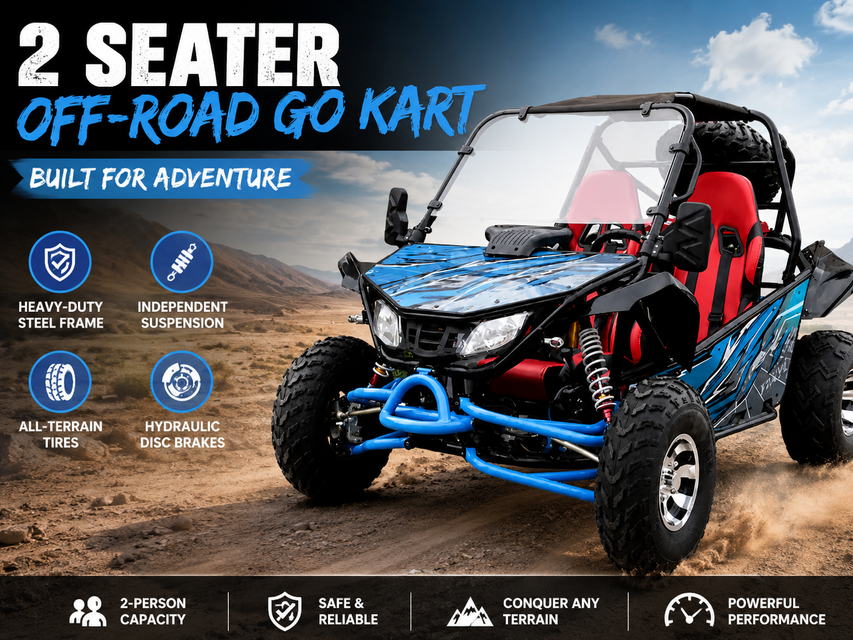
An off road go kart, commonly called a buggy or dune buggy, is built for unpaved ground: dirt tracks, trails, sand, ranch land, and rough yards. It typically runs large-diameter knobby tires, a tubular steel chassis with generous ground clearance, and long-travel suspension so the wheels keep contact over bumps and dips. Most production buggies seat two people side by side and are powered by a single-cylinder gasoline engine, commonly in the 150 cc to 250 cc range, with a growing number of electric models available. In the wholesale market, buggies are the strongest movers for dealers and rental fleets because demand spans recreation, agriculture, and tourism.
Road Go Karts
Road karts are designed for paved surfaces: karting tracks, parking-lot events, indoor venues, and smooth private roads. They typically use slick or semi-slick tires, a low ride height, and a chassis tuned for cornering. Engine options range from small four-stroke units for entry-level rental fleets to higher-output motors for sports use. For B2B buyers, road karts are the backbone of commercial karting, where durability and low cost per lap matter more than peak speed.
Utility Go Karts
A utility go kart trades sporty handling for carrying capacity. These machines are built for work: moving tools, feed, water, and equipment around farms, warehouses, workshops, and large properties. The typical layout includes a rear cargo bed, a drivetrain tuned for low-end pulling power, and suspension set up for load stability rather than cornering. Gasoline and electric versions are both common; electric utility karts are increasingly popular indoors and on farms where noise and emissions matter. Dealers find that utility karts reach a different customer entirely — landscapers, maintenance crews, and small farms — making them a valuable line extension.
Kids Go Karts
Kids karts are smaller, slower, and safety-focused, built for children from about three to twelve years old. Typical features include adjustable speed limits, low seat heights, simplified controls, and lighter frames. They sell in high volume through toy and outdoor retail channels, and many B2B buyers use them as an entry price point that builds customers for later upgrades. From a sourcing view, kids karts are the most price-sensitive category, so packaging and freight cost are decisive in wholesale planning.
Frame Construction: What to Inspect Before You Commit
The frame is the most important quality indicator in a go kart, because it is the one part you cannot easily upgrade after purchase. Most production frames are welded from round or square steel tube. Ask your go kart supplier for the tube wall thickness and grade, and for the welding method used in production. A well-built frame uses continuous, clean welds, gussets or reinforcement plates at high-stress joints such as the steering mount and engine cradle, and a durable coating that resists rust. Weight is a useful sanity check: all else being equal, a heavier machine usually means more steel.
Two practical tips from the field: ask for photos of the bare frame before paint to judge weld quality, and request the rated load and recommended rider weight in writing — some suppliers quote a frame that suits a 60 kg rider but not a 120 kg one, and that difference matters for rental fleets and utility work.
Gasoline vs Electric: Choosing the Powertrain
Powertrain choice drives the running cost, the service routine, and the customer experience, so it deserves deliberate analysis. Gasoline karts are still the default in most catalogs: they refuel in minutes, offer familiar maintenance, and tend to carry a lower initial wholesale price, but they bring fuel cost, noise, exhaust in enclosed venues, and the need to stock spare engines. Electric karts cost more upfront but run cheaper per hour, operate quietly with zero exhaust, and have fewer wearing parts; the trade-offs are battery range, charging time, and charging-bank logistics for fleets.
In practice, many karting venues choose electric for indoor tracks and gasoline for outdoor tracks. For off-road buggies, gasoline remains the majority choice because trail users value range and quick refueling; for utility karts, electric is winning on farms and in warehouses. Ask the supplier for realistic range and charge-cycle figures on electric models, and confirm parts availability on the engines they install — your service life depends on that supply chain.
Seating and Ergonomics
Seating is where comfort meets liability. Most adult karts use bucket seats, either one-piece or split two-piece designs on two-seater buggies. Check seat width and harness openings: a rental kart that is too narrow draws complaints and wears its belts against the frame. Look for adjustable seat rails or multiple seat positions on models meant for shared use, and thick, high-density foam on vehicles driven for hours. Two-seat off-road buggies should offer equal legroom and harnesses on both sides, because the passenger position is often neglected. Also confirm the maximum rider weight supported by seat and frame together, and keep it in your product materials so customers self-select the right model.
Safety Equipment: Roll Cages, Seat Belts and Beyond
Safety specification is where low-cost quotes hide the biggest gaps. Verify these points model by model, in writing, before you negotiate price:
- Roll cage: full welded roll cage with gusseted joints on off-road buggies and utility karts; lower rollover risk on track karts, but check the design anyway.
- Seat belts: three-point belts are the minimum on adult karts; four- or five-point harnesses are common on off-road buggies; kids karts usually use a lap belt with a speed limiter.
- Brakes: hydraulic disc brakes front and rear are the standard to look for on adult machines; mechanical brakes appear on entry-level kids karts.
- Kill switch: an easily reached engine kill switch or driver tether is expected on racing-style and off-road karts.
- Protection: bumpers, nerf bars, and side protection where legs meet the frame, plus reflectors or lights if the kart may be used near roads.
- Speed control: on kids karts, a physical speed limiter or adjustable governor is the norm, and some markets treat it as a requirement.
Treat every safety item as a line in the quotation: a supplier who lists a roll cage and seat belts as standard on a buggy but prices them as options elsewhere is telling you how they sell.
Certification and Compliance
Certification is not one global stamp. Requirements depend on your destination market: the European Union generally requires CE marking for machinery, other regions have their own standards, and some countries demand extra documentation for import customs clearance. Ask the factory which certificates they hold, which models are covered, and which are included in the price rather than added as an extra. Verify by asking for test reports and certificate numbers, and check whether the certificate comes from an accredited body or is a self-declaration. If you sell into several markets, confirm that one certificate does not automatically cover the others — most suppliers answer honestly, and that honesty is itself a signal of a reliable partner.
Wholesale Pricing, MOQ and Lead Times
B2B terms vary, but a few generic patterns hold across the industry. Most go kart suppliers set a minimum order quantity on standard models, commonly in the range of 10 to 50 units, while customized models such as private-label colors or logo application usually require more. Some suppliers offer mixed-container programs so you can combine models to reach the minimum — valuable for dealers building a full range. Typical export lead times run from 25 to 45 days after deposit confirmation, longer for custom finishes. Payment is commonly structured around a deposit with the balance before shipment, and a pre-shipment inspection is standard practice for serious buyers.
Freight deserves its own line in your cost model. Go karts are bulky, and shipping them fully assembled wastes container space. Most factories ship semi-knocked-down or partially assembled, cutting volume per unit and freight cost significantly. Ask for the loaded container quantity per model — that number belongs in your margin calculation next to unit price and MOQ.
How to Pick a Reliable Go Kart Supplier
A good go kart supplier is a partner in your margin, not just a source of units. Use this checklist when you evaluate factories:
- Check specialization: a factory that only builds go karts knows its product; a general manufacturer treats them as a side line.
- Ask for a factory profile, production photos, and spec sheets for the full range, and compare sheets across models to see whether figures are consistent.
- Request a sample or pre-production unit before a full order; if that is not possible, ask for detailed photos and videos of the production line.
- Confirm what is included in the price: engine, battery, charger, tools, spare parts kit, owner manual, and packaging — optional extras change the comparison.
- Verify certifications and test reports, and confirm the coverage matches your destination market.
- Test communication: response speed, answer quality, and willingness to engage with technical questions are early signals of after-sales behavior.
- Ask about spare parts supply and warranty terms — most suppliers commit to a parts availability window and a warranty period, so get both in writing.
- Consider go kart wholesale programs that offer mixed containers, private label options, or regional exclusivity, and confirm which terms apply to your order size.
Most suppliers are happy to walk a serious buyer through their process, so treat the first inquiry as a test of the relationship, not just a price request.
Off-Road vs Road vs Utility vs Kids: Comparison Table
The table below summarizes the practical differences to weigh when planning your product range.
| Aspect | Off-Road Go Kart (Buggy) | Road Go Kart | Utility Go Kart | Kids Go Kart |
|---|---|---|---|---|
| Primary terrain | Dirt, sand, trails, rough yards | Paved tracks, streets, event lots | Farms, warehouses, worksites | Flat yards, parks, driveways |
| Typical customers | Rental fleets, dealers, tourism operators | Karting venues, event organizers | Landscapers, farmers, maintenance crews | Toy and outdoor retail channels |
| Typical powertrain | Gasoline 150-250 cc, or electric | Small four-stroke to high-performance | Gasoline or electric, work-tuned | Small gasoline or electric, speed-limited |
| Suspension focus | Long travel, big bumps | Cornering grip, low ride height | Load stability | Basic, low speed |
| Key safety items | Full roll cage, harnesses, bumpers | Guards, kill switch, strong brakes | Cage or canopy, tie-downs | Speed limiter, lap belt, low seat |
| Cost position | Mid to high | Mid | Mid to high | Entry |
| Wholesale fit | Container programs, high volume | Fleet orders, repeat business | Regional dealer lines | High volume, price-sensitive |
FAQ: Go Kart Buying Questions from B2B Buyers
What is the difference between an off road go kart and a road go kart?
An off road go kart uses knobby tires, high ground clearance, and long-travel suspension for dirt, sand, and rough terrain, usually with a full roll cage. A road go kart is built for paved surfaces, with slick tires, a lower ride height, and a chassis tuned for cornering. The same engine size can appear in both, but the frames, suspension, and safety setups are different products.
Are electric go karts a good option for a rental fleet?
For indoor or flat-surface venues, electric karts are often the better fleet choice: lower running costs, quiet operation, no exhaust, and fewer wearing parts. The trade-offs are battery range, charging time, and managing a charging bank. For long off-road trail use, gasoline karts remain more common because refueling is faster and range matters less. Ask the supplier for realistic range figures before committing.
What is a typical MOQ for go kart wholesale orders?
Minimum order quantities vary by supplier and model, but a common range on standard models is roughly 10 to 50 units, with larger minimums for customized or private-label orders. Some go kart suppliers offer mixed-container programs so you can combine models to reach the minimum. Confirm the MOQ, lead time, and payment terms in writing before planning inventory.
Do kids go karts need the same safety equipment as adult models?
No. Kids karts are designed around speed limiting, low seat heights, and simple lap belts, while adult machines carry full roll cages, hydraulic brakes, and multi-point harnesses. Some markets apply specific safety requirements to children's vehicles, so confirm the certification needed in your destination market before ordering.
How can I tell if a go kart supplier is reliable?
Look for a factory that specializes in go karts, provides complete spec sheets, shares production photos, and answers technical questions clearly. Ask for samples or pre-production units, verify certifications and test reports, and confirm what is included in the price. Most reliable suppliers are transparent about MOQs, lead times, warranty terms, and spare parts, so put every commitment in writing.
Can I mix different go kart models in one container?
Yes, many suppliers accept mixed containers, which lets you build a range — for example, one off-road buggy, one road kart, and one kids kart — from a single order. This is usually subject to a minimum total quantity and may affect lead time. Ask for the loaded container quantity per model so you can plan freight accurately.
Whichever category you choose, apply the same discipline: define the use case, verify the frame and safety specification, confirm certification for your market, and build a complete landed-cost model that includes freight, MOQ, and spare parts. A clear buying process separates a supplier relationship that grows from one that costs you money.