
UTV Content Marketing: How Dealers Can Build a Content Cluster That Ranks
Learn how UTV content marketing helps dealers rank: build a content cluster with a pillar page, supporting articles, and a linking structure that converts.
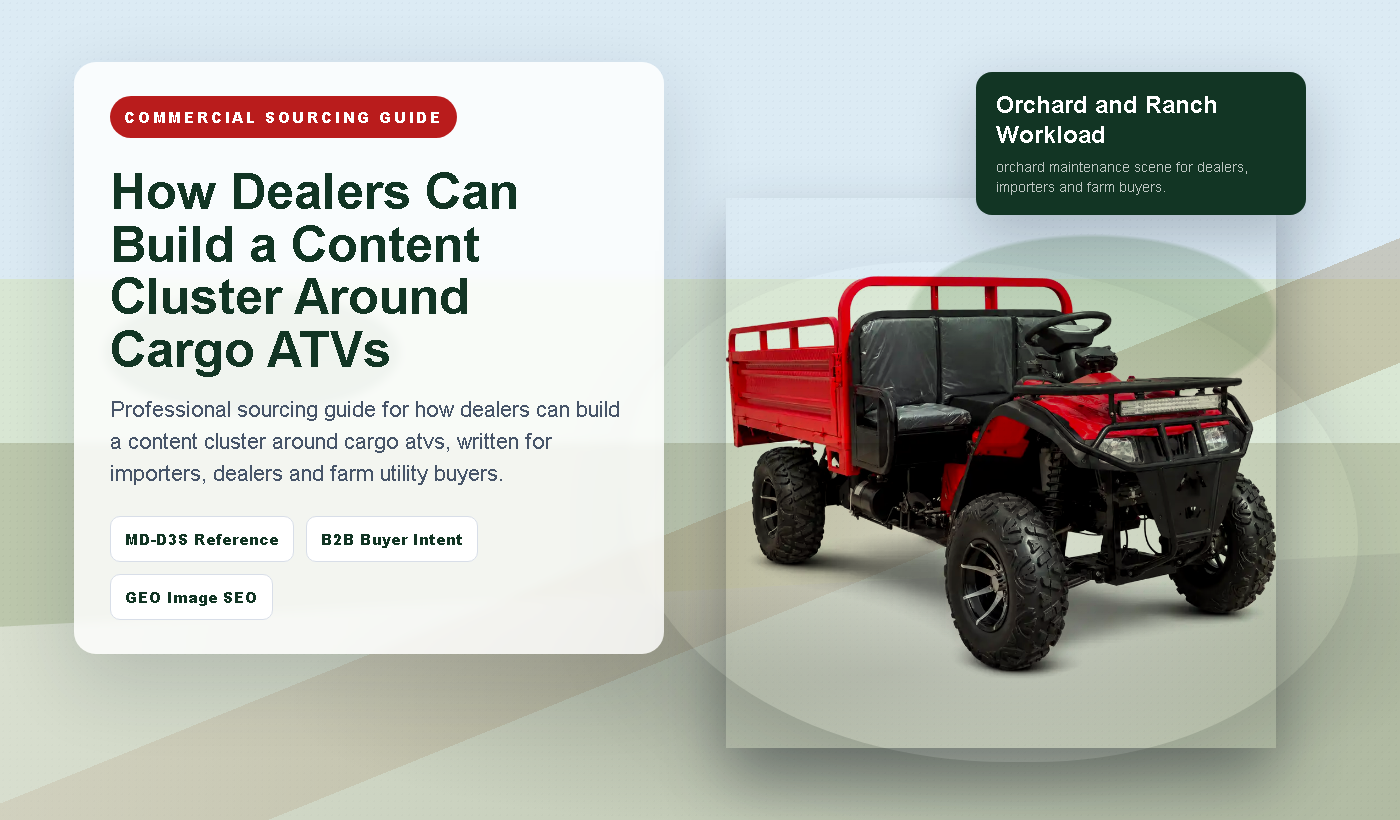
UTV Content Marketing: How Dealers Can Build a Content Cluster That Ranks
UTV content marketing is no longer a nice-to-have for dealers, importers, and OEM sourcing teams. A single promotional post about a new model rarely earns rankings, and it certainly does not earn trust. Buyers researching a side-by-side purchase — or deciding which supplier to import from — read many pages before they ever contact a dealer. If your site answers their questions with depth and structure, you capture that research traffic and convert it into qualified leads. This guide explains how to build a UTV content cluster: a topic hub anchored by a pillar page, supported by focused articles, and tied together with deliberate internal links. You will learn the keyword research approach, the page types, and the metrics that prove the strategy works.
Why a Content Cluster Beats Random Blog Posts for UTV SEO
Most dealer websites publish blog posts in isolation: one week a tire comparison, the next a press release about a new model, then a generic article about choosing an off-road vehicle. Each page competes alone, earns a few visits, and quietly dies. A content cluster works differently. Every article is written to answer one specific question, and every article points to — and is pointed at — a pillar page that covers the topic comprehensively. Search engines can then see a topic hub: a network of pages that establishes your site as the authority on UTVs in your market.
This structure also aligns with how search engines evaluate relevance: ranking well is not just matching a keyword, but demonstrating that your site covers a topic thoroughly and coherently. When a pillar page links out to supporting articles and they link back, the signals reinforce one another. Each new article deepens the hub, and the hub lifts every page in it.
For B2B buyers — importers comparing suppliers, dealers evaluating product lines, sourcing teams vetting OEMs — depth is a trust signal in itself. A dealer who explains suspension geometry, export lead times, and financing structures reads like someone who has actually sold UTVs. That first-hand experience is the E-E-A-T signal search engines look for, and exactly what a professional buyer verifies before picking up the phone.
UTV search behavior is different from car shopping
UTV buyers do not behave like car shoppers. A car buyer might search for a model and price in one session; a UTV buyer often researches for weeks. They compare engine displacement, seating capacity, cargo capacity, and suspension travel, and they read about warranties, parts availability, and service networks. They also search in different seasons — utility work in spring, hunting in fall, riding year-round — and a significant share of queries carries B2B intent: utv dealer near me, side by side supplier, utv oem manufacturer, import atv and utv from overseas suppliers.
Because intent varies so widely, a single generic page cannot satisfy every query. A UTV blog built as a cluster matches one intent per article — a first-time buyer comparing models, a dealer evaluating an import program, an owner hunting for parts diagrams. The more precisely a page matches intent, the better it converts, and the stronger the signal it sends back to the hub.
UTV Content Marketing: Pillar Pages and Supporting Articles
Every content cluster rests on two page types, and the distinction matters more than most dealers realize.
The pillar page
The pillar page is the topic hub — the definitive, broad guide that covers a subject so completely that it answers almost any question about it. For a UTV dealer, a strong pillar might be a complete buying guide or an explanation of UTV types and how they differ. It is long, structured with clear headings, evergreen, and aimed at the highest-value keyword in the topic, such as utv buying guide or types of utvs.
Supporting articles
Supporting articles are narrow, single-intent pieces that expand on one section of the pillar. Where the pillar devotes a section to engine displacement, a supporting article goes deep into engine sizes compared; where it mentions financing, an article covers how dealer financing works. Each targets a specific long-tail keyword, answers exactly one question, and links up to the pillar with a descriptive anchor. Together they form the cluster.
| Aspect | Pillar page | Supporting article |
|---|---|---|
| Role in the cluster | Topic hub that defines the subject | Expands one section of the pillar |
| Target keyword | Broad head term, e.g. utv buying guide | Specific long-tail term, e.g. utv engine sizes compared |
| Length | Comprehensive, typically 2,000+ words | Focused, typically 800 to 1,500 words |
| Search intent | Mixed: research, comparison, purchase | Single, precise intent per article |
| Links | Links down to every supporting article | Links up to the pillar and across related articles |
| Update cadence | Reviewed and refreshed continuously | Rewritten when the topic evolves |
| Example | The Complete UTV Buying Guide | UTV Cargo Capacity: How Much Can a Side-by-Side Haul? |
How to Build a Content Cluster: A Five-Step Dealer Content Strategy
Building a cluster is a planning exercise first and a writing exercise second. Follow these five steps in order:
- Map the buyer journey and collect real questions.
- Run keyword research that matches search intent.
- Identify topic gaps your competitors ignore.
- Write and publish the pillar page first.
- Publish supporting articles and link inward consistently.
Step 1 — Map the buyer journey
Before researching keywords, map the questions your buyers actually ask. For a UTV dealer or manufacturer, the journey usually has four stages: awareness (what is a utv vs an atv), consideration (best utv for farm work), comparison (gas vs electric utv), and decision (utv dealer financing, utv warranty coverage). B2B buyers add a parallel journey: supplier evaluation (utv manufacturer reviews, oem utv supplier, import duties on utvs). Write down every question you have been asked at the shop, at trade shows, in email, and on social media. This list is the raw material for your cluster.
Step 2 — Use a keyword research approach that matches intent
Keyword research for a cluster starts with one core topic, not ten unrelated keywords. Choose the topic you can own — for most dealers that is a category-level topic like UTVs or side-by-sides. Expand it into hundreds of queries with a keyword tool, then sort them by monthly search volume as a proxy for demand, competition level, and commercial value (does the query suggest someone close to a purchase?). Group the queries into subtopics — types, engines, usage, financing, maintenance, and supplier questions. Each subtopic becomes a supporting article; the parent topic becomes the pillar.
Pay special attention to long-tail queries with clear buyer intent, such as utv with the most cargo capacity for farming or side by side supplier for dealerships. These convert better than head terms and are far easier to rank for, especially for a local or mid-size dealer competing against national sites.
Step 3 — Find the gaps your competitors ignore
Review the top-ranking pages for your target terms and note what they miss. Most UTV content on the web targets recreational buyers; dealers and B2B buyers are underserved, with rare content on dealer margins, import programs, parts availability, and fleet utility. Those gaps are where a dealer content strategy wins: the pages you publish there face weak competition and attract exactly the buyers you want.
Step 4 — Write the pillar page first
Write the pillar as a complete reference with an introduction, a table of contents, and section headings that preview each supporting article. Keep sections substantive but leave the deep dives to the articles. Publish the pillar first, then build supporting articles against it — the pillar defines the cluster's vocabulary and structure, keeping later articles consistent.
Step 5 — Publish supporting articles and link inward
Publish one supporting article at a time, in order of commercial value. After each article goes live, link it to the pillar and to related articles, then return to the pillar and reference the new piece. This link-inward habit is what turns a collection of blog posts into a topic hub.
Internal Linking Structure for UTV SEO
Internal links are the plumbing of the cluster. Without them, the pillar and articles exist in isolation and the hub never forms. Follow a simple, consistent pattern:
- Every supporting article links up to the pillar with a descriptive anchor like complete UTV buying guide — never click here.
- The pillar links down to every supporting article from the section that covers the same subtopic.
- Related articles link to each other when one genuinely extends the other, for example an engine-size article linking to a maintenance article.
- Commercial pages participate too. A model page can link to the relevant guide, and the guide can link to the model line, so ranking pages pass authority toward your money pages.
Anchor text should describe the destination naturally — a cargo-capacity page linked with UTV cargo capacity guide, never a generic phrase — and anchors should stay varied across pages. Finally, review links every quarter so the pillar's section list grows with each new article.
Example UTV Content Cluster Outline
To make the model concrete, here is a working outline for a UTV dealer or manufacturer building a topic hub around the topic UTVs.
Pillar page: The Complete UTV Buying Guide — targets utv buying guide, types of utvs, and utv vs atv.
Supporting articles:
- UTV vs ATV: Which One Fits Your Buyer's Needs?
- UTV Types Explained: Utility, Sport, and Multi-Purpose Models
- UTV Engine Sizes Explained: 500cc, 700cc, and 1000cc Compared
- UTV Cargo Capacity: How Much Can a Side-by-Side Haul?
- Gas vs Electric UTVs: Total Cost of Ownership for Dealers
- UTV Warranty Coverage: What Dealers and Importers Should Verify
- UTV Financing for Buyers: How Dealer Programs Work
- UTV Parts and Service: What to Look For in a Supplier Network
- How to Import UTVs: Lead Times, Documentation, and Compliance Basics
- UTV Winter Maintenance: A Checklist for Owners
Notice the structure: the pillar covers the topic broadly, each article answers one question, the import, warranty, and parts pieces speak to B2B readers, and every article links back to the pillar. Ten articles deepen the hub, and the hub lifts every page in it — that is the difference between a UTV blog and a content cluster.
Measuring Results: KPIs for a UTV Blog That Ranks
A content cluster is an investment, and it deserves the same measurement discipline as any other. Track these indicators monthly and review them quarterly:
| KPI | What it tells you | How to read it |
|---|---|---|
| Rankings for cluster keywords | Whether the topic hub is gaining authority | Track the pillar plus 10 to 20 long-tail terms; expect movement within 3 to 6 months |
| Organic sessions to the cluster | Whether the pages attract research traffic | Compare month over month and by season |
| Internal link clicks | Whether readers move through the hub | High pillar-to-article clicks mean the structure works |
| Lead form submissions and quote requests | Whether content converts to pipeline | Attribute by landing page and by campaign |
| Time on page and scroll depth | Whether the content holds attention | Low engagement usually means an intent mismatch |
| Inbound links | Whether other sites cite the hub as a resource | Each citation strengthens E-E-A-T for the whole cluster |
Set expectations honestly: a new cluster does not rank overnight. With consistent publishing and correct internal links, most dealers see movement on long-tail terms within a few months and on the pillar within a year. If a page is not moving, review its intent match, its links, and whether the content is genuinely better than what ranks above it.
Common Mistakes to Avoid
- Writing for keywords instead of buyers. A cluster built around ranking alone produces thin, repetitive content. Write for the buyer's question first; the keyword simply names the page.
- Publishing without a plan. Random articles never form a topic hub. Decide the pillar and the article list before writing anything.
- Forgetting internal links. A perfect article that links nowhere is a dead end for crawlers and readers alike.
- Ignoring commercial pages. If the cluster never points toward your model pages and contact forms, it builds authority without pipeline.
- Letting the pillar go stale. Model lineups, emission rules, and import rules change. Refresh the pillar every quarter, and update articles when the facts shift.
- Copying manufacturer content. Reusing supplier copy duplicates existing pages and adds no first-hand value. Your shop floor experience, service records, and buyer conversations are the content competitors cannot copy.
FAQ: UTV Content Marketing Questions Dealers Ask
How long does it take for a UTV content cluster to rank?
Most dealers see measurable movement on long-tail terms within three to six months of consistent publishing, and the pillar typically strengthens over the first year. The timeline depends on the competition in your market, the age of your domain, and how consistently you publish and build internal links.
How many articles do I need before the cluster works?
There is no fixed minimum, but a practical starting point is one pillar plus eight to twelve supporting articles. The structure matters more than the count: every article must answer one question well and link back to the pillar. After the first cluster is live, you can build a second one around a related topic, such as side-by-side accessories or UTV maintenance.
What is the difference between a content cluster and a topic hub?
They describe the same model from two angles. A content cluster is the set of pages — one pillar and its supporting articles — connected by internal links. A topic hub is what that set becomes from the reader's and search engine's perspective: a single destination where the whole topic lives. You build a cluster; you present a topic hub.
Can a dealer with a small team maintain a content cluster?
Yes, if you pace the work. One well-researched article per week builds a complete cluster in roughly three months. Reuse your own material — service records, buyer questions, trade show notes — as article ideas, and refresh the pillar quarterly rather than rewriting it. Consistency beats volume.
What UTV content converts best for B2B buyers?
Content that reduces risk: import and compliance guides, warranty and parts coverage explanations, supplier evaluation checklists, and total-cost-of-ownership comparisons. Professional buyers are trying to verify that you are a dependable partner. Pages that demonstrate process knowledge and after-sale support convert better than any spec sheet.
How often should I update the pillar page?
Plan a substantive review every quarter. Update model lineups, pricing context, regulations, and any internal links to new articles. Even small refreshes tell search engines the page is maintained, which supports the trust signals behind UTV SEO.
A content cluster will not replace your showroom, but it will bring a better class of traffic to your site: buyers who are already deep in research and suppliers who are evaluating you as a partner. Define the pillar, map the articles, link them deliberately, and measure honestly. That is UTV content marketing done the way it actually works — and it compounds.